
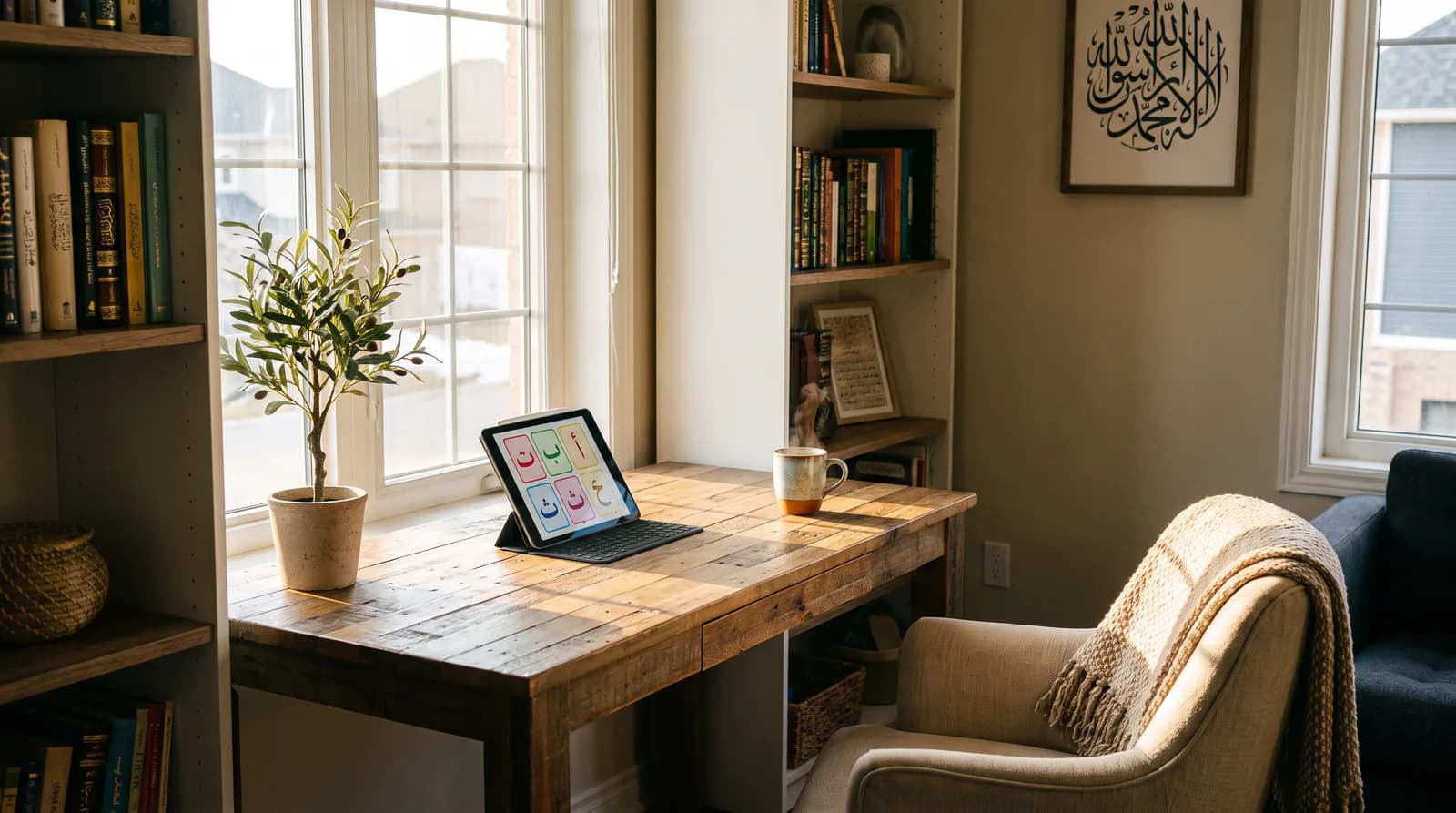
Discover how private 1:1 live online classes build Arabic speaking confidence for Muslim children in the West through peer interaction and Islamic Tarbiyah.
Many Muslim children in the West can decode the Arabic script beautifully. They finish a page of the Quran with care, yet freeze when asked a simple question like kayfa haluk? (how are you?). This is the confidence gap, and it is one of the most common concerns we hear from parents. It is not a failure of intelligence or effort. It is a gap between reading and speaking, and it often widens quietly through the school years.
This guide looks at how small-group live online classes can close that gap. We connect the science of peer-supported language acquisition with the Islamic concept of Tarbiyah (تربية) — nurturing character alongside skill — and show how Western Muslim families can build lasting Arabic speaking confidence without adding more pressure to already full weeks.
The Confidence Gap: Why Diaspora Muslim Kids Hesitate to Speak Arabic
Walk into many Muslim homes in North America, the UK, or Australia and you will find a child who reads Arabic with Tajweed (تجويد) but speaks it with hesitation. The reasons are layered.
First, reading and speaking are different skills. Decoding Quranic Arabic trains the eye and the tongue to follow a text. Conversation requires retrieving words in real time, constructing a sentence, and risking a mistake in front of another person. For many children, the second skill is practiced far less.
Second, heritage language learners often carry a quiet perfectionism. They hear a parent or grandparent speak fluently and decide their own Arabic is not good enough. Rather than try and stumble, they stay silent. This is especially common in the tween years, when social awareness peaks and peer judgment feels heavy.
Third, the Western school week is demanding. By the time a child finishes homework, extracurriculars, and dinner, the mental energy required to attempt a new language is low. An exhausted child rarely volunteers to speak. You can read more about these dynamics in our post on Arabic literacy for heritage speakers in the West.
The result is a child who can read the Quran but cannot order a meal, greet a cousin, or follow a short conversation. The confidence gap is real, and it rarely closes on its own.
The Science of Small Groups: How Peer Interaction Lowers Language Anxiety
Language anxiety is not a character flaw. It is a normal response to being asked to perform in a high-stakes setting. Research on peer interaction shows that when children learn alongside a few familiar peers, the stakes drop. They are not performing for a whole classroom or for a single adult. They are talking with friends.
According to the Canadian Child Care Federation, peer interactions are a core driver of children's language development. Children imitate, negotiate, and repair communication with each other in ways that are less threatening than adult-led drills. When a peer mispronounces a word, the child learns that mistakes are normal and recoverable.
Small-group teaching also gives English as an Additional Language (EAL) learners more opportunities to speak. Learning Village notes that small-group instruction reduces anxiety and increases participation because students feel safer taking risks. The same principle applies to Arabic.
In a small-group live online class, your child hears other children attempt the same phrases. They hear laughter when someone mixes up a word. They hear a peer ask for help. Over time, the classroom becomes a place where speaking is normal, not exceptional.
This is where Tarbiyah (تربية) enters the picture. In an Islamic framework, the classroom is not just a place to acquire a skill. It is a place to practice character — patience when a peer struggles, encouragement when someone is shy, humility when you make a mistake yourself. A teacher who models this creates a culture where children feel supported rather than judged.
For a deeper look at how group dynamics shape confidence, see our article on why small groups work better.
More Speaking Time, Faster Progress: The 5-to-8 Student Sweet Spot
Class size matters more than most parents realize. In a group of twenty, a child might speak for thirty seconds in an hour. In a group of five to eight, the same child can speak for ten to fifteen minutes — and hear peers speak for much longer.
Why is five to eight the sweet spot? Fewer than five and the group can feel like a series of one-on-one turns, which increases pressure on each child. More than eight and the quieter children disappear into the background. Five to eight allows for pair work, small games, and enough variety that every child gets both speaking time and listening time.
Listening time is not wasted time. When children hear peers use a phrase, they store it. When they hear a peer make a mistake and get corrected gently, they learn the rule without the embarrassment of being the one corrected. This is one reason peer interaction accelerates vocabulary and grammar acquisition.
Strong Foundations Homeschool notes that small-group learning helps young children develop social skills alongside academic ones. In a language class, those social skills are not a side benefit. They are the mechanism. Children speak because they want to connect with the other children in the room.
At Minhaj Kids, live groups are kept small so that every child gets adequate speaking time while still benefiting from peer listening and collaborative activities. You can see how this fits into our broader approach on the Arabic program page.
Fostering Tarbiyah (تربية) Through Collaborative Online Learning
Tarbiyah (تربية) is often translated as upbringing or nurturing. It is the process of shaping a child's character, habits, and relationship with faith. In an Arabic class, Tarbiyah shows up in how children treat each other.
Consider a simple moment: a child mispronounces alhamdulillah. In a harsh environment, another child might laugh. In a Tarbiyah-centered environment, the teacher pauses, thanks the child for trying, and invites the group to repeat the word together. The mistake becomes a shared moment rather than a source of shame.
This is not softness for its own sake. It is a deliberate pedagogical choice rooted in Islamic character. The Prophet ﷺ taught gentleness, and a classroom that reflects that teaching produces children who are more willing to take risks. Risk-taking is the engine of language acquisition.
Collaborative activities — pair dialogues, group storytelling, peer interviews — give children a reason to speak that is not about being tested. They are speaking to complete a task with a friend. The focus shifts from Am I correct? to Can we finish this together?
Parents often ask how to reinforce this at home. Our guide on supporting Arabic between live classes offers practical ideas that align with the same nurturing approach.
For families thinking about the wider curriculum, our post on Tarbiyah and engagement in Islamic studies explores how character and content work together across subjects.
Overcoming the Perfect Pronunciation Pressure in a Safe Space
Many children in the West grow up hearing that Arabic pronunciation must be perfect. This is understandable. Quranic recitation has rules, and parents want their children to read beautifully. But when the same standard is applied to conversation, it can paralyze a child.
Conversational Arabic and Quranic recitation are related but distinct. In conversation, the goal is communication. A child who says ana bikhayr with a slightly flat vowel is still communicating. Correction can come later, gently, after the child has built the habit of speaking.
Small-group classes create a safe space for this. Because the group is small, the teacher can hear each child and offer targeted, kind correction. Because peers are also making mistakes, your child does not feel singled out.
This balance is delicate. Too much correction and the child stops speaking. Too little and errors fossilize. A skilled teacher reads the room and adjusts. This is one reason teacher quality matters as much as class size. Our article on vetting online Islamic tutors walks through what to look for.
For children who are especially shy, the first weeks may involve more listening than speaking. That is okay. Confidence builds in layers. Our post on helping shy children participate in online classes offers strategies that apply to Arabic as well.
Balancing Individual Attention with Peer Motivation
One-on-one lessons have a clear advantage: the teacher's full attention. But they also have a hidden cost. When a child is the only student, every mistake is public. There is no peer to hide behind, no friend to laugh with, no model to imitate.
Small groups offer a middle path. The teacher still knows each child by name and tracks their progress. But the child also benefits from peer motivation. When a classmate answers a question, your child thinks, I can do that too. When a classmate tells a short story, your child wants to tell one as well.
This peer effect is especially powerful for heritage speakers who understand more Arabic than they speak. They have passive vocabulary. Hearing peers use that vocabulary actively pulls it into their own speech.
Bingo School, writing about online learning for bilingual children, notes that online formats can increase participation for children who are shy in physical classrooms. The screen offers a slight buffer, and the small group offers social warmth. Together, they create a space where speaking feels possible.
Individual attention and peer motivation are not opposites. The best small-group classes weave them together: a quick individual check-in, then a paired activity, then a group game. Your child gets both.
Integrating Live Arabic Practice into the Western School Week
Time zones and school terms are practical realities that many language programs ignore. A class scheduled at 9 p.m. on a school night will not get your child's best energy. A program that runs through the Western summer break may conflict with family travel.
Western Muslim families need schedules that respect the local school week. That means afternoon or early evening slots, breaks that align with school holidays, and recordings for the weeks when life intervenes.
Minhaj Kids schedules live classes around local school terms and time zones, making consistent attendance easier for diaspora families. Every session is recorded for home review, which bridges the gap between live classes and independent practice. If your child misses a session, they can watch the recording and still follow the conversation.
Consistency matters more than intensity. Twenty minutes of live speaking practice three times a week will do more for confidence than a two-hour session once a week. The goal is to make Arabic a regular, low-stress part of the week.
This is where the transition from Quranic reading to conversational speaking becomes practical. Many children already have a Quran routine. Adding a small-group Arabic conversation class does not replace that routine. It complements it. Our guide on building a consistent Quran routine can help you see how the two fit together.
For families managing multiple children and activities, our posts on parental burnout and overscheduling and managing enrichment activities offer realistic ways to protect your family's energy.
What Parents Can Do Between Classes
You do not need to speak Arabic fluently to support your child. Small, consistent actions make a difference.
- Ask your child to teach you one phrase from class. Teaching reinforces learning and shifts the dynamic from testing to sharing.
- Play the class recording during a low-energy moment, like folding laundry or driving. Passive review counts.
- Celebrate attempts, not just accuracy. A child who tries a new sentence deserves recognition even if the grammar is imperfect.
- Keep a simple phrase jar. Each week, add one conversational phrase your child learned and practice it at a natural moment.
- Connect with other families in the class. When children know their peers outside class, speaking feels more natural.
These small habits align with the Tarbiyah (تربية) mindset: patience, encouragement, and consistency over pressure.
Choosing the Right Small-Group Class
Not every small-group class is created equal. As you evaluate options, consider these questions:
- How many students are in a live session? Five to eight is ideal for speaking confidence.
- How much time does each child actually speak? Ask for a sample schedule.
- How does the teacher handle mistakes? Look for warmth and gentle correction.
- Are sessions recorded? Recordings support review and missed classes.
- Does the schedule respect your local school term and time zone?
- Is there a clear progression from reading to speaking?
Our article on comparing weekend mosque, full-time Islamic school, and online options can help you weigh formats. For a broader look at the landscape, see the state of Islamic education in the Western diaspora.
When Progress Feels Slow
Language confidence rarely moves in a straight line. A child may speak freely one week and go quiet the next. This is normal. Growth often looks like a plateau followed by a sudden jump.
If you are worried, talk to the teacher. Ask what they observe in class. Sometimes a child is speaking more than you realize, just not at home. Sometimes a change in group composition or schedule can help.
Our post on measuring progress beyond grades offers a wider lens for evaluating growth. And if your child is navigating identity questions alongside language learning, this article on identity and faith commitment may be helpful.
A Gentle Path Forward
Arabic speaking confidence is not built by force. It is built by repeated, low-stakes opportunities to speak with people who make the child feel safe. Small-group live classes offer exactly that: enough peers to make conversation natural, enough teacher attention to guide growth, and enough warmth to make mistakes feel okay.
When that environment is shaped by Tarbiyah (تربية), the benefits extend beyond language. Your child learns to encourage a struggling classmate, to laugh at their own mistakes, and to keep trying. Those habits serve them in Arabic and in life.
If you are ready to explore a small-group Arabic class for your child, you can review our fees and plans to find a fit for your family. You can also learn more about our approach, browse the journal for more parent guides, or contact us with questions. For related reading, see Arabic is not just grammar and from Sunday school to lifelong learners.
References
- How to promote peer interactions to benefit children's language skills — CCCF, 2024.
- 10 Benefits of Online Learning for Bilingual Children — Bingo School, 2024.
- The Benefits of Small Group Learning for Young Children — Strong Foundations Homeschool, 2026.
- Why provide EAL learners with small-group teaching? — Learning Village, 2023.
- The Advantages of Online Learning Classes — Tribeca Language, 2021.