
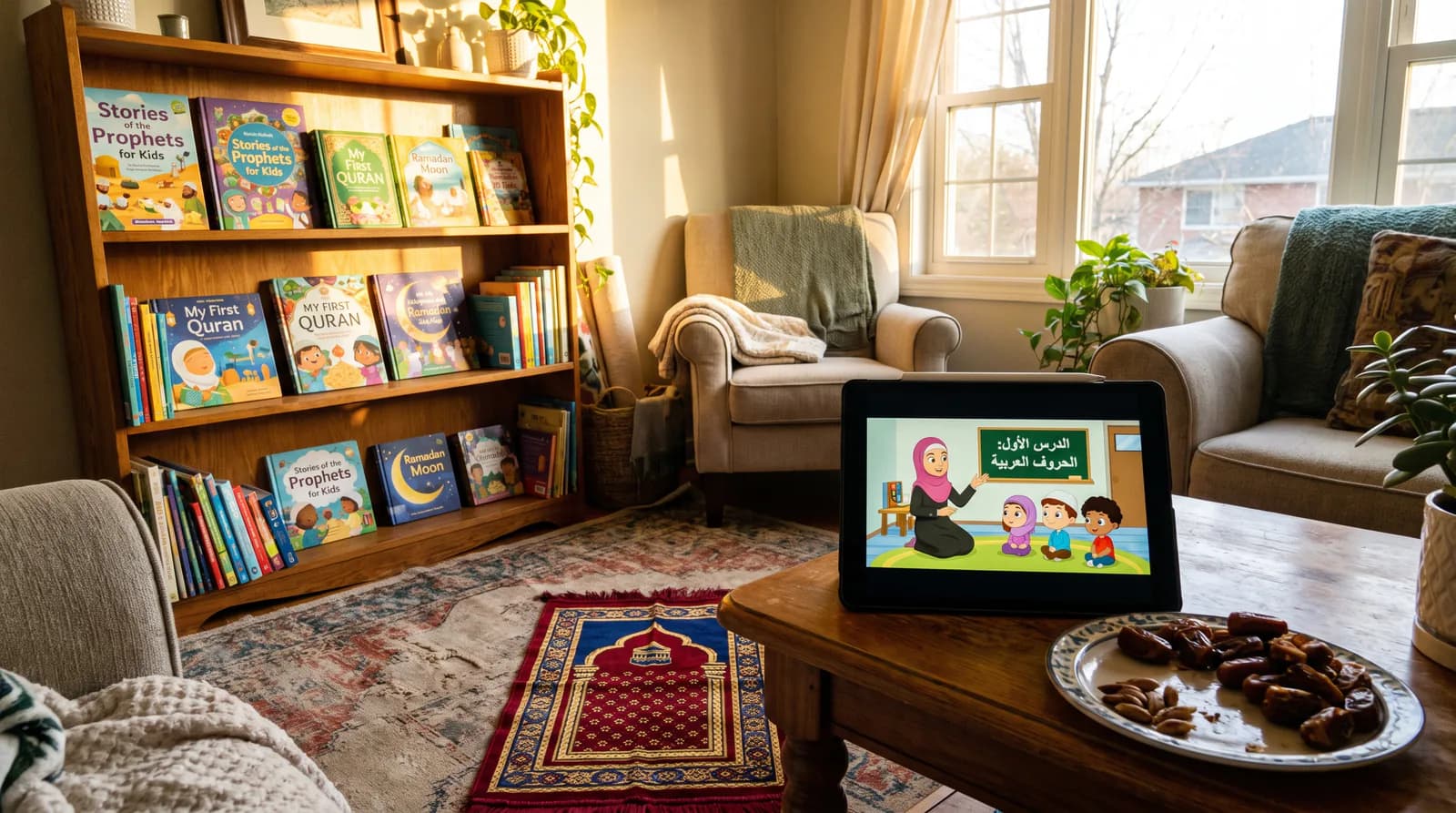
Explore how family, school, and structured online learning shape Muslim youth identity and long-term faith commitment in the UK & USA. Practical guide for.
Muslim Youth Identity and Long-Term Faith Commitment in the West: How Family, School, and Online Learning Shape the Next Generation
Raising children with a strong, resilient Muslim identity in the UK and USA is a profound responsibility and a modern challenge. Western Muslim parents often navigate a 'dual identity' landscape, where Islamic values intersect with secular cultural norms. Research consistently shows that parental influence is the most significant factor in intergenerational faith transmission, but families need effective tools. This article offers a practical, evidence-informed framework for nurturing faith commitment in children aged 5–14, highlighting how structured, live online Islamic learning can integrate seamlessly into modern family life.
The Dual Landscape: Navigating Muslim Identity in the West
Muslim youth in Western countries face unique pressures. They must balance their Islamic heritage with the cultural norms of their residing nation, a process often described as 'dual identity' negotiation. According to a 2025 analysis by IQRA, challenges include peer pressure, social media influence, and limited access to quality Islamic education. However, these challenges also present opportunities for parents to proactively build a strong foundation.
Understanding the 5–14 Age Window
Most discussions focus on teenagers, but identity formation begins much earlier. Children aged 5–14 are in a critical phase where core beliefs, habits, and attachments are formed. Early interventions—such as consistent Quran recitation, understanding of Islamic values, and positive community experiences—can significantly impact long-term commitment. A 2020 study by Yaqeen Institute emphasizes that religious identity develops through a combination of family modeling, religious education, and personal experiences.
The Foundational Role of Family: Nurturing Faith at Home
Parents are the primary architects of their children's faith. A 2023 study published in MDPI confirms that parental influence—through modeling religious practices, open communication, and providing religious experiences—is the strongest predictor of faith retention. Yet many parents struggle with how to effectively instill faith amidst busy schedules and secular influences.
Practical Strategies for Parents
- Modeling: Let your children see you pray, read Quran, and engage in dhikr. Actions speak louder than words.
- Open Communication: Create a safe space for questions about faith, doubt, and identity. Avoid shaming; instead, explore answers together.
- Consistent Routines: Integrate Islamic practices into daily life—morning duas, family Quran time, and weekly Islamic discussions.
- Positive Reinforcement: Celebrate small achievements in learning and practice to build intrinsic motivation.
For more on building love for deen without pressure, read our article on building love for salah and deen.
School's Influence: Balancing Secular Education with Islamic Values
Schools in the UK and USA are often secular environments that may not accommodate Islamic practices or values. Muslim children may face challenges such as conflicting teachings (e.g., evolution vs. creation), lack of prayer space, or social pressures around dating and alcohol. A 2025 article by Islamic Research and Information Center notes that the secular educational system can sometimes nullify belief in God if not counterbalanced with strong Islamic grounding.
Supporting Your Child at School
- Communicate with teachers about religious needs (prayer, dietary requirements).
- Supplement school learning with Islamic perspectives on science, history, and ethics.
- Build a strong Islamic identity at home so children feel confident in their beliefs.
- Consider homeschooling or hybrid models. Our guide on homeschooling Muslim children offers practical integration tips.
The Power of Online Learning: A Structured Approach to Faith Commitment
For many Western Muslim families, access to quality Islamic education is limited. Local mosques may offer weekend classes, but these often lack structure, qualified teachers, and consistency. Online learning has emerged as a vital tool, but not all online programs are equal. Structured, live, small-group online Islamic education offers unique benefits for children aged 5–14.
Why Structured, Live Online Learning Works
Research on online Islamic learning impact shows that interactive, live sessions increase engagement and retention. Minhaj Kids takes this further with:
- Small Groups (3–5 students): Enhances participation, confidence, and community building. Learn why small groups work better.
- Al-Azhar-Aligned Curriculum: Authentic knowledge with structured progression in Quran, Arabic, and Islamic Studies.
- Ijaza-Certified Teachers: Qualified educators who understand Western contexts.
- Flexible Scheduling: Accommodates time zones, school terms, and Ramadan.
- Recorded Sessions: Allows review and reinforcement.
- Parental Progress Updates: Keeps you involved in your child's learning journey.
This approach directly addresses the logistical challenges Western families face. For more on quality standards, see our post on online Islamic tutor quality and safeguarding.
Building Critical Thinking Through Structured Learning
A deep, authentic understanding of Islam equips children to counter confusion and superficial interpretations they may encounter online or from peers. Our curriculum encourages questions and critical thinking, not rote memorization. This is essential for developing a faith that can withstand doubt and external pressures. For insights on navigating doubt, read navigating faith and doubt in Muslim teens.
Building Resilience: Equipping Children for Lifelong Faith
Resilient faith commitment is not just about knowledge; it's about identity, belonging, and practice. A 2024 guide by Yaqeen Institute emphasizes strategies like fostering a sense of community, encouraging service, and teaching Islamic coping mechanisms. Online learning platforms can play a key role by providing a safe, supportive community of peers and mentors.
Measuring Progress Beyond Grades
True faith commitment is not measured by test scores. Look for signs like enthusiasm for learning, willingness to practice, and thoughtful questions. Our article on measuring Islamic education progress offers guidance on holistic assessment.
Minhaj Kids: A Partner in Your Child's Faith Journey
At Minhaj Kids, we understand the unique challenges of raising Muslim children in the West. Our structured, live online programs are designed to complement family efforts and school education, providing a strong foundation for lifelong faith commitment. With flexible scheduling, qualified teachers, and a child-friendly approach, we help your child build a confident Muslim identity.
Ready to give your child the gift of authentic Islamic learning? Explore our programs and find the right fit for your family. View our fees and start your journey today.
References
- Challenges Faced by Muslim Teens in the West and How to Address Them — IQRA, 2025.
- Navigating faith: Addressing the main challenges of young Muslims in Western countries — Islamic Research and Information Center (IRIC), 2025.
- Will My Children Be Muslim? The Development of Religious Identity in Young People — Yaqeen Institute for Islamic Research, 2020.
- Raising Resilient Muslim Youth: Strategies for Building a Strong Muslim Identity in Children — Yaqeen Institute for Islamic Research, 2024.
- The Importance of Early Islamic Education for Children in Non-Muslim Majority Countries — Home Mosque, 2025.
- Evaluating the impact of online Islamic learning among Indonesian Muslim adolescents — RSIS International, 2024.
- Parental Influence and Intergenerational Transmission of Religious Belief, Attitudes, and Practices: Recent Evidence from the United States — MDPI, 2023.