
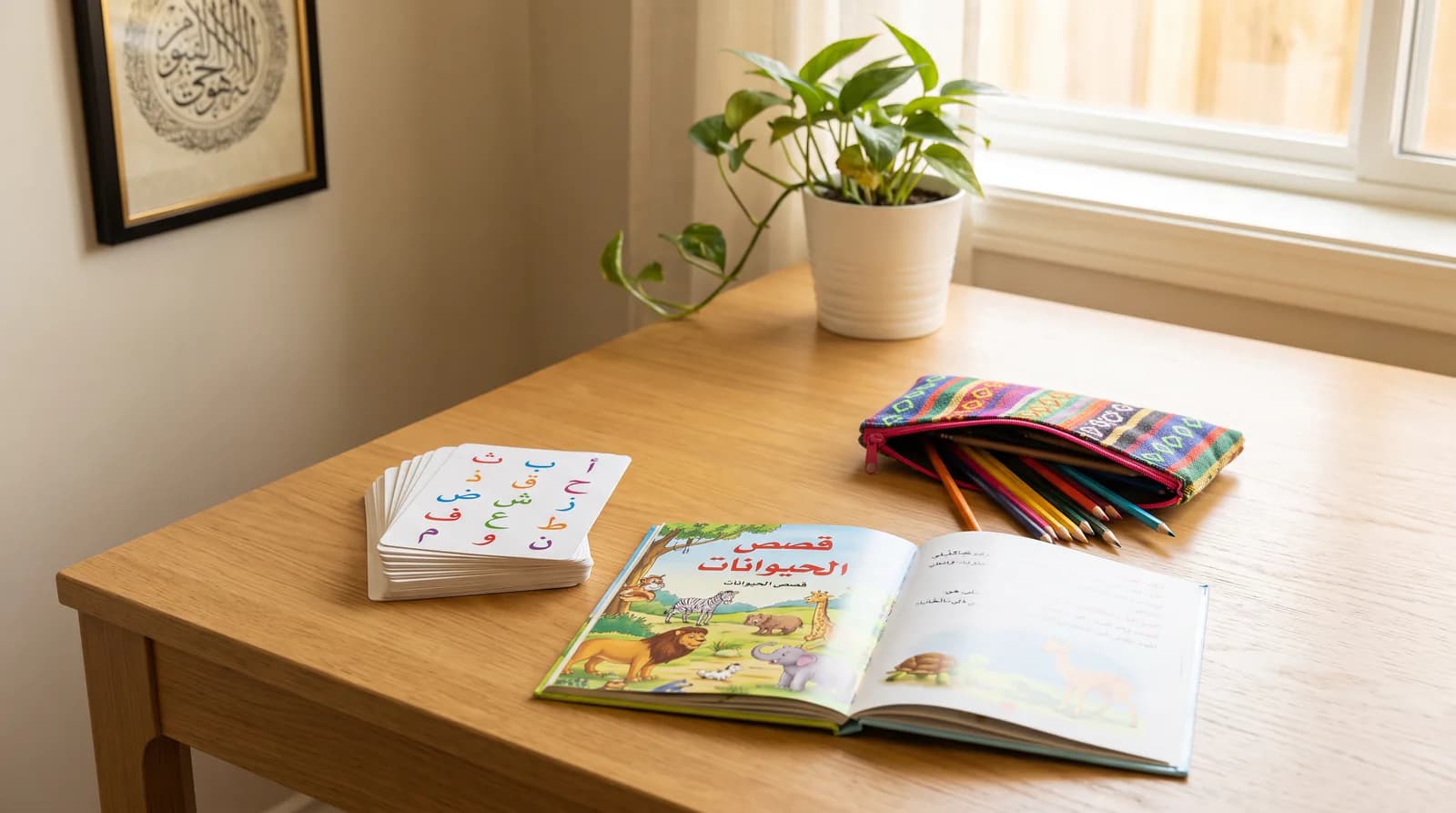
Discover why conversational Arabic isn't enough for heritage-speaking Muslim children in the West. Learn effective strategies for developing strong Arabic.
Why Conversational Arabic Alone Isn't Enough for True Literacy
Many Muslim families in the West take pride in speaking Arabic at home. Children learn to understand and respond in the family dialect, navigating everyday conversations with ease. Yet when it comes to reading a Quranic verse, writing a short paragraph in Modern Standard Arabic (MSA), or understanding a children's book, these same children often struggle. This is the 'bilingual but not biliterate' reality faced by many heritage Arabic speakers (source: ResearchGate, 2020).
Conversational fluency in a dialect is a valuable asset, but it does not automatically transfer to literacy in MSA or Classical Arabic. The two are distinct linguistic systems with different vocabulary, grammar, and syntax. A child who can ask for a glass of water in a dialect may not recognize the written form of the same concept in MSA. For deeper engagement with the Quran, Islamic texts, and broader Arabic literature, formal literacy is essential. It also provides significant cognitive benefits, enhancing memory, problem-solving, and overall academic performance.
In this article, we explore why conversation alone is insufficient and provide evidence-informed strategies to help your child become truly literate in Arabic.
The Unique Challenges of Heritage Arabic Learners in the West
The 'False Beginner' Phenomenon
Heritage speakers often present as 'false beginners' in formal Arabic classes. They have a strong oral foundation but lack reading and writing skills. This can lead to frustration: they feel they 'know' Arabic but cannot demonstrate it in a classroom setting. Teachers may place them in beginner classes where they are bored, or in advanced classes where they are overwhelmed. This mismatch is a common reason why many Western Muslim children stop learning Arabic (source: Medium, 2023).
Diglossia and Its Impact
Arabic is diglossic: the spoken dialect differs significantly from the written standard. Children exposed only to a dialect at home may find MSA almost like a new language. Qualified tutors who understand diglossia can leverage the child's dialect as a stepping stone, pointing out similarities and differences, rather than ignoring it. This approach builds confidence and accelerates literacy.
Time Constraints and Scheduling
Western school schedules, extracurricular activities, and time zone differences (UK, USA, Canada, Australia, Ireland) make consistent Arabic learning challenging. During Ramadan, schedules shift further. Without a flexible yet structured program, literacy development stalls. Live online classes with recorded sessions, like those offered by Minhaj Kids, allow families to fit learning into their unique routines.
Bridging the Gap: The Role of Structured Learning and Qualified Tutors
Why Formal Instruction is Non-Negotiable
Research shows that heritage language learners benefit from explicit instruction in literacy skills (source: Taylor & Francis Online, 2024). While immersion at home supports oral fluency, reading and writing require systematic teaching of the Arabic script, spelling rules, grammar, and text comprehension strategies.
The Power of Small, Live Online Groups
Private 1:1 class settings (one child per class) provide personalized feedback and interactive learning that passive consumption or large classes cannot offer. In a private 1:1 class, each child receives individual attention, and the tutor can adjust pacing to meet diverse needs. This is particularly effective for heritage speakers who may have uneven skills—strong in speaking but weak in writing. At Minhaj Kids, our classes are intentionally small to maximize engagement and progress.
Qualified, Ijaza-Certified Tutors
Not all native speakers are effective teachers. Tutors need pedagogical training and an understanding of heritage learner challenges. Ijaza-certified tutors, trained in Al-Azhar-aligned curricula, know how to bridge the gap between dialect and MSA. They can pre-teach vocabulary, introduce grammar in context, and use multisensory techniques to reinforce learning. This expertise is crucial for moving beyond conversation to literacy.
Effective Strategies for Developing Reading and Writing Skills
Start with Reading Comprehension
Focus on reading comprehension before expecting full writing production. Use leveled readers with engaging stories that build vocabulary and grammar incrementally. Pre-teach key words, then read together, discussing meaning. This approach reduces frustration and builds confidence. For heritage speakers, reading familiar stories in MSA can be a powerful bridge.
Systematic Phonics and Script Mastery
Arabic script requires explicit instruction. Many children know the alphabet but struggle with letter connections and cursive writing. Use tracing sheets, sand trays, or apps that focus on letter formation. Daily practice of 10-15 minutes is more effective than longer, sporadic sessions.
Writing as a Process
Start with copying words and sentences, then move to dictation, and finally to creative writing. Encourage journaling about daily life in Arabic. Use prompts that relate to their experiences. For heritage speakers, writing about familiar topics (e.g., family traditions, favorite foods) bridges the gap between oral and written language.
Grammar in Context
Rather than isolated grammar drills, teach grammar as it appears in texts. When reading a story, point out verb conjugations or noun-adjective agreement. This contextual learning sticks better. Arabic is not just grammar—it's a living language.
Fostering a Literate Arabic Environment at Home
Create a Print-Rich Space
Label household items in Arabic (both MSA and dialect if helpful). Display Arabic posters, calendars, and children's work. Have a small library of Arabic books at varying levels. The goal is to normalize written Arabic in daily life.
Use Technology Wisely
Apps and websites can support literacy, but passive screen time is not enough. Choose interactive apps that require active response (e.g., typing, matching, recording). Pair app use with real-world reading and writing. Recorded lessons from Minhaj Kids allow children to review at their own pace, reinforcing what was learned in live class.
Integrate Literacy into Daily Routines
Read an Arabic bedtime story, write a shopping list together in Arabic, or send a text message in Arabic to a grandparent. Small, consistent practices build literacy without feeling like a chore. For older children, encourage them to follow Arabic social media accounts or watch Arabic cartoons with subtitles.
Support Between Classes
Parents play a key role in reinforcing learning between formal classes. However, many parents lack pedagogical expertise. Support Arabic between live classes with simple strategies provided by your tutor. Consistency is more important than intensity.
Choosing the Right Path: Live Online Learning for Lasting Literacy
Why Minhaj Kids Works for Heritage Families
Minhaj Kids offers structured, live online Arabic literacy classes in private 1:1 classes, taught by qualified, Ijaza-certified tutors. Our Al-Azhar-aligned curriculum is designed for heritage speakers, acknowledging their oral skills while systematically building reading and writing proficiency. We address the 'false beginner' challenge through careful placement, ensuring each child is in the right level.
Flexibility for Western Schedules
Our classes accommodate time zones across the UK, USA, Canada, Australia, and Ireland. Recorded sessions allow for review and catch-up. During Ramadan, we adjust schedules to support family routines. This flexibility ensures consistent progress without adding stress.
Proven Results
Parents report that their children go from struggling with the alphabet to reading short stories independently within months. The combination of expert instruction, private 1:1 class dynamics, and parent support creates an environment where literacy flourishes. Why private 1:1 classes work better for heritage learners is rooted in personalized attention and peer interaction.
Take the Next Step
Your child's journey to Arabic literacy starts with the right support. Don't let conversational fluency be a ceiling—help them unlock the full richness of the Arabic language. Explore our Arabic literacy programs and see how we can partner with you. For more insights, read about measuring progress beyond grades and raising children on the Quran.
Ready to begin? Check our fees and enroll today.
References
- Arabic heritage students and their language-learning experiences. Limits and highlights — ResearchGate, 2020.
- The Role of Literacy in Heritage Language Acquisition — Authorea, 2024.
- Strategies for Reading in Arabic — University of Wisconsin Pressbooks, Undated. (Link removed: resource no longer available)
- Towards understanding heritage literacy — Taylor & Francis Online, 2024.
- Heritage language and linguistic theory — PMC / Frontiers in Psychology, 2013.
- Why Western Muslims Stop Learning Arabic — Medium, 2023.
- Bilingual but not biliterate: the literacy of heritage language learners — UDSpace - University of Delaware, 2021.
- Arabic for Heritage Speakers — Columbia University, Undated.
- Supporting Arab & Muslim Students in the Classroom — Education Week, 2020.