
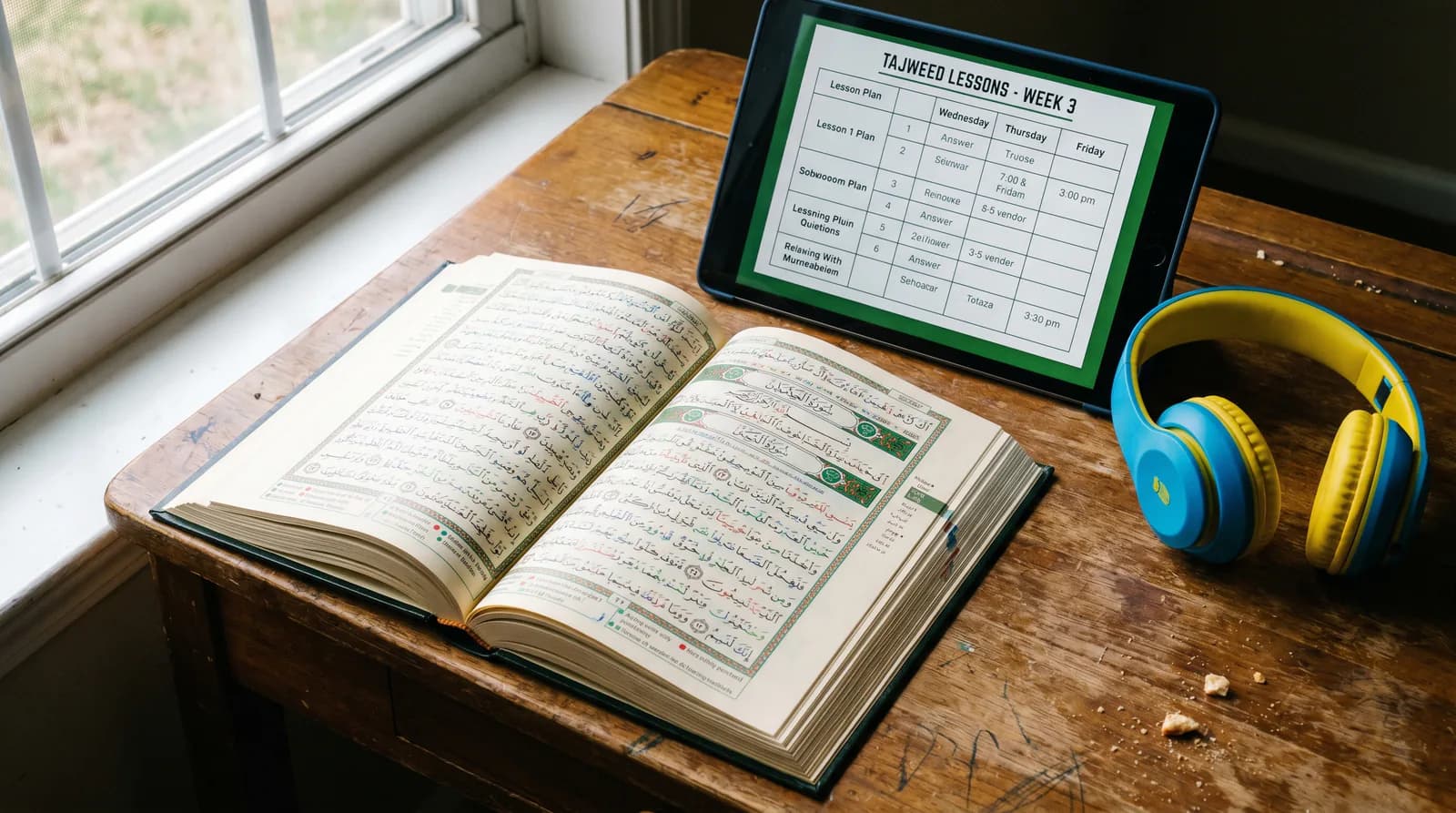
Explore why ad-hoc Tajweed instruction fails Muslim children in the West. Learn how structured, Al-Azhar-aligned programs build proper recitation skills.
The Diaspora Challenge: Why 'Just Reading' Isn't Enough
For Muslim families raising children in Western countries, teaching the Quran is both a sacred duty and a formidable challenge. Many parents who themselves learned Tajweed intuitively as children in Muslim-majority settings are surprised to find their own children struggle with the same sounds. The reality is that diaspora children are growing up in a different linguistic environment. Their ears are attuned to English phonology, not the rich Arabic soundscape. Simply handing them a Quran and expecting them to "pick it up" through osmosis is a recipe for frustration and, more critically, for fossilized errors that become extremely hard to unlearn later.
In this article, we examine the most common systemic failures in Tajweed instruction available to Western Muslims and explain how structured, pedagogically sound programs — like those offered at Minhaj Kids — directly address these shortcomings.
Systemic Failure 1: The Rote Memorization Trap
Many local mosques and community centers rely on volunteer teachers who prioritize speed and memorization quantity over phonetic accuracy. A child may be praised for memorizing a juz quickly, even if their pronunciation of the letter Qaf (ق) is indistinguishable from Kaf (ك), or if they consistently merge the heavy and light Lam (ل). This approach, known as rote memorization without corrective feedback, leads to what Tajweed experts call "fossilized errors" — mistakes that become ingrained and require intensive effort to correct later.
In contrast, structured programs like the Quran program at Minhaj Kids emphasize accuracy from day one. Every letter is taught with its correct articulation point (Makhraj), and students are not allowed to move to the next level until they demonstrate mastery. This may slow down initial progress, but it builds a solid foundation that prevents the need for costly re-learning later.
Systemic Failure 2: Overlooking the Non-Native Learner Gap
A widespread assumption among heritage-language tutors is that diaspora children have an innate ear for Arabic sounds simply because their parents speak Urdu, Bengali, or Somali at home. In reality, these children are effectively second-language learners of Quranic Arabic. Their native English phonology interferes with their ability to distinguish and produce sounds like Ayn (ع), Ghayn (غ), and the emphatic consonants (ص ض ط ظ).
Research in second language acquisition confirms that explicit phonetic instruction is essential for learners whose first language lacks these sounds. A study published in Frontiers in Psychology (NIH, 2019) found that children learning a second language benefit significantly from targeted phonological training, especially when it is integrated into a structured curriculum. Without such instruction, children develop what teachers call "Tajweed blind spots" — they simply cannot hear or produce certain letters correctly, no matter how many times they repeat them.
Minhaj Kids addresses this gap by incorporating Arabic phonology lessons into the Tajweed curriculum. Our teachers are trained to identify common error patterns among English speakers and to provide targeted exercises that retrain the ear and mouth. For more on how we support learning between live classes, see our post on supporting Arabic between live classes.
Systemic Failure 3: Inconsistent Teaching and Curriculum Gaps
Many diaspora families piece together their child's Quran education by switching between different tutors, weekend schools, and online platforms. This patchwork approach creates gaps in foundational rules. For example, a child may learn the rules of Nun Sakinah (نون ساكنة) from one teacher but then move to another tutor who assumes they already know it, skipping review and jumping straight to Madd (مد). The result is a shaky understanding that leads to errors in recitation.
This inconsistency also makes it difficult for children to build a sustainable Quran routine. Our guide on how to build a consistent Quran routine for school-age children offers practical tips, but the underlying issue is systemic: without a standardized syllabus, progress is unpredictable.
Structured programs solve this by using a fixed scope and sequence. At Minhaj Kids, our Tajweed curriculum is divided into clear levels, each with specific learning objectives. Every student, regardless of which teacher they are assigned, follows the same progression. This ensures that no rule is skipped and that every student masters the basics before moving on. It mirrors the consistency that Western parents expect from secular education — and it works.
The Power of Structure: Sequential Learning in Tajweed
Cognitive Load Theory, as outlined by the Centre for Education Statistics and Evaluation (NSW Government, 2017), teaches us that human working memory has limited capacity. When too much new information is presented at once, learning is impaired. This is exactly what happens when a tutor throws all the rules of Tajweed at a child in a single session, or when a curriculum jumps haphazardly between topics.
Structured curriculums break complex Tajweed rules into digestible, sequential levels. Students first master the articulation points of the letters (Makharij), then progress to the inherent properties of letters (Sifaat), then to the rules of Nun Sakinah and Tanween, and so on. Each level builds on the previous one, reducing cognitive overload and allowing deep learning to take place.
This approach is especially effective in private 1:1 class settings, where the teacher can give individual attention to each student's articulation. Learn more about why we use this model in our post on why private 1:1 classes work better.
Why Pedagogy Matters: Qualified Tutors vs. Just Reciters
One of the most critical factors in Tajweed instruction is the quality of the teacher. A tutor may be an excellent reciter themselves — perhaps even a Hafiz — but that does not automatically make them an effective teacher, especially for non-native children raised in Western educational systems that value structured, sequential learning.
The Learning Policy Institute (2016) emphasizes that teacher quality is the single most important school-based factor in student achievement. In the context of Tajweed, this means teachers need not only mastery of the Quran but also training in how to convey that knowledge to young learners. They must understand child development, classroom management, and second-language pedagogy.
Minhaj Kids hires teachers who are not only qualified in Quranic sciences (many hold Ijazah or have studied at Al-Azhar) but are also trained in modern teaching methods. We verify credentials and provide ongoing professional development. For more on how we ensure quality and safeguarding, see our article on online Islamic tutor quality, safeguarding, and curriculum.
Moving Forward with Confidence and Correctness
For parents who want their children to recite the Quran with proper Tajweed, the path is clear: move away from ad-hoc, volunteer-led instruction and toward structured, pedagogically sound programs. The evidence is overwhelming — whether from cognitive science, second-language acquisition research, or the lived experience of thousands of diaspora families — that systematic instruction produces vastly better outcomes than unstructured approaches.
At Minhaj Kids, we are committed to providing exactly this kind of education. Our Quran program combines a sequential curriculum, qualified teachers, and private 1:1 class settings to ensure every child masters Tajweed correctly and confidently. We invite you to explore our Quran program page and see how we can support your child's journey with the Book of Allah.
If you have questions or would like to learn more about our approach, please contact us or read more about our overall educational philosophy on our about page. You can also browse our blog for more articles on Islamic education in the West, including topics like homeschooling Muslim children, Islamic education in the West: a 2026 review, and inclusive Islamic pedagogy for learning differences.
Ready to give your child the gift of correct Quran recitation? Explore our fees and enroll today.
References
- Islamic Education in the West: Approaches to Teaching Islam in Schools — ResearchGate (Dr. Mohamad Abdalla), 2020.
- Cognitive Load Theory: A Research-Based Guide for Teachers — Centre for Education Statistics and Evaluation (NSW Government), 2017.
- The Importance of Qualified Teachers for Student Success — Learning Policy Institute, 2016.
- Second Language Acquisition in Childhood — National Institutes of Health (NIH) / Frontiers in Psychology, 2019.
- Teaching Arabic as a Foreign Language in the UK — British Council, 2016.