
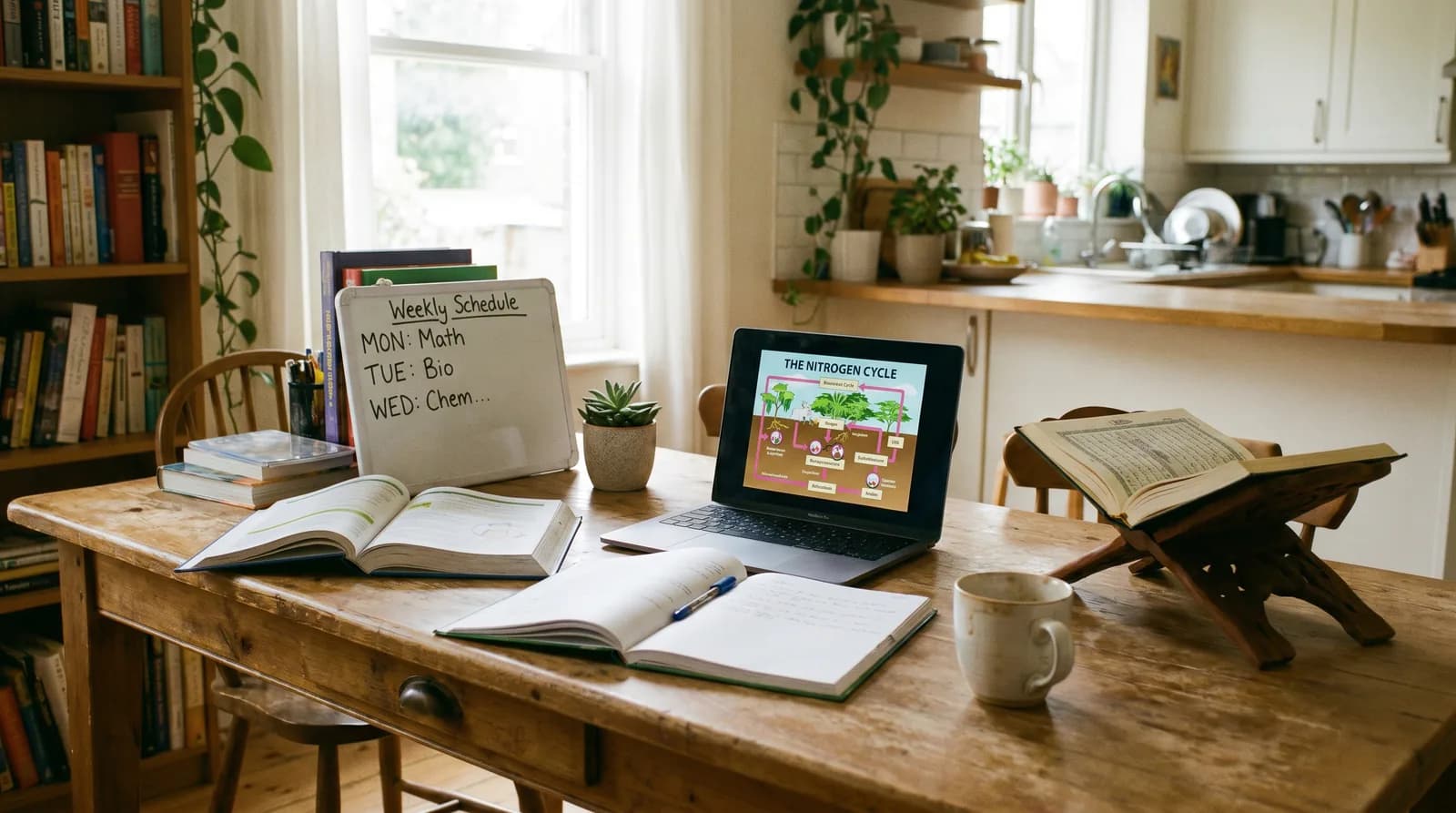
A practical guide for Muslim parents in the West on integrating secular subjects with structured Islamic learning in a homeschool setting. Learn scheduling.
The Rise of Muslim Homeschooling in the West
Across the UK, US, and Canada, a quiet revolution is taking place in Muslim households. More and more parents are choosing to homeschool their children, driven by a desire for a faith-centered education, dissatisfaction with public school environments, and concerns about peer pressure and negative social influences. This trend reflects a deep commitment to raising children who are proud of their Islamic identity while excelling in secular subjects. Homeschooling allows parents to align every aspect of learning with family values, creating a cohesive educational experience that public or even private Islamic schools may not always provide.
However, the journey is not without its challenges. The primary struggle for Muslim homeschooling parents is the delicate balancing act: covering state-required secular subjects while ensuring a robust Islamic education. Many parents feel overwhelmed by the dual responsibility and fear gaps in either academic or religious knowledge. A common pitfall is treating secular and religious studies as entirely separate, competing silos, which can lead to burnout and a fragmented learning experience for the child.
The Challenge: Balancing Secular Requirements with Deen
For Muslim parents in the West, homeschooling means navigating two parallel tracks. On one hand, there are compulsory subjects like math, English, science, and history, often with specific standards to meet. On the other hand, there is the desire to teach Quran recitation with Tajweed, Arabic language, Islamic studies, and instill a love for worship. Without a thoughtful plan, parents can easily feel like they are running two separate schools under one roof.
Research shows that Muslim homeschooling is rising precisely because it offers a solution to the value conflicts found in mainstream schooling. According to a study on ResearchGate, many Muslim families choose homeschooling to protect their children from negative peer influence and to provide a more holistic education that integrates faith with learning (ResearchGate, 2018). Yet, the same study highlights that parents often struggle with time management and curriculum design. The key is to move away from a fragmented approach and toward a unified educational philosophy that sees secular and religious knowledge as complementary.
Designing a Holistic Schedule Around Prayer and Focus
One of the most effective strategies for balancing secular and deen education is strategic scheduling. Instead of replicating the rigid 8-3 public school day, successful homeschoolers use block scheduling or looping to manage multiple subjects without burnout. The day can be anchored around prayer times, which naturally segment the day into focused blocks. For example, the morning hours after Fajr are often when children are most alert—an ideal time for Quran memorization and Arabic, as the mind is fresh and receptive.
Here is a sample schedule framework that many Muslim homeschoolers find effective:
- Morning Block (after Fajr): Quran recitation, memorization, and Arabic vocabulary. This is the spiritual anchor of the day.
- Mid-Morning Block (after Ishraq): Core secular subjects—math and English. These require the most concentration and are best tackled early.
- Late Morning Block (before Dhuhr): Science or history, with an integrated Islamic perspective (e.g., linking science to Allah's creation).
- Afternoon Block (after Dhuhr): Lighter subjects like art, physical activity, or project-based learning. This can also include Islamic studies stories.
- Evening (after Asr): Review of the day, independent reading, or online classes for specialized subjects like Tajweed.
Consistency is more important than rigidity. Parents should adapt the schedule to their child's natural rhythms and family commitments. For more ideas, check out our post on building a consistent Quran routine for school-age children.
Integrating Faith into Everyday Subjects
A holistic approach to homeschooling involves weaving Islamic perspectives into secular subjects. This teaches children that faith is relevant to all aspects of life, not just isolated 'religion time.' For instance, when studying biology, parents can discuss the perfection of Allah's creation and the concept of signs (ayat) in nature. In history, lessons on the rise and fall of civilizations can be connected to Islamic principles of justice and accountability. Even math can be enriched by exploring patterns in nature as a reflection of divine order.
This integration does not require a complete curriculum overhaul. Simple adjustments, such as choosing literature that features Muslim characters or using historical examples from Islamic civilization, can make a significant difference. The goal is to create a seamless worldview where knowledge is seen as a gift from Allah and every subject can deepen one's faith. For more on this, read our article on Islamic education: answering parents' questions in the West.
The Power of Outsourcing: Structured Quran & Arabic Learning
One of the biggest sources of stress for Muslim homeschooling parents is teaching Quran recitation with Tajweed and Arabic, especially for non-native speakers. These subjects require specialized knowledge and consistent practice. Many parents find that trying to teach these skills themselves leads to frustration and gaps in the child's learning. The solution is outsourcing to structured, expert-led programs.
Online platforms like Minhaj Kids offer live, interactive classes for Quran, Arabic, and Islamic studies, taught by qualified teachers. By enrolling your child in a structured program, you ensure educational quality, a clear progression path, and a consistent routine. This frees up significant parental time and mental energy to focus on core secular subjects like math and English. It transforms a source of parental stress into a structured, expert-led part of the child's week.
Outsourcing also provides accountability and social interaction with peers, which is especially valuable for only children or those in small homeschooling groups. Consider our Quran program and Arabic program for a comprehensive approach. You can also read about the benefits of private 1:1 class learning in our post why private 1:1 classes work better.
Socialization and Character Development Beyond the Classroom
A common myth about homeschooling is that children are isolated. In reality, homeschooling offers flexibility for character development, volunteering, and real-world socialization within diverse community groups. Muslim homeschoolers often form cooperatives (co-ops) where families meet regularly for group learning, field trips, and Islamic events. Children interact with peers of various ages and backgrounds, which can be more natural than age-segregated classrooms.
Furthermore, homeschooling allows parents to intentionally cultivate character traits like responsibility, empathy, and independence. Children have more time to engage in community service, develop hobbies, and pursue interests in depth. The goal is not to shelter children but to prepare them to confidently navigate the world while holding onto their values. For insights on handling social pressures, see our guide on Muslim teens, social media, and peer pressure.
Conclusion: Embracing the Journey with Confidence
Homeschooling Muslim children in the West is both a challenge and a blessing. It requires careful planning, flexibility, and a willingness to seek help when needed. By designing a holistic schedule that integrates faith into all subjects, outsourcing specialized deen learning, and embracing community for socialization, parents can provide a rich, balanced education that nurtures both academic excellence and deep iman.
Remember, you don't have to do it all alone. Minhaj Kids is here to support you with structured online programs that complement your homeschool journey. Explore our programs and fees to see how we can help your child thrive.
References
- Examining Schooling Options for Muslim Children — SoundVision, 2024.
- The new homeschooling: More diverse, just as committed — The Hechinger Report, 2022.
- Homeschool Schedule for Multiple Kids: Templates That Work — Savvy Learning, 2025.
- Muslim Homeschooling — ResearchGate, 2018.
- Teaching Arabic to Non-Native Children: 10 Tips and Tricks — SoundVision, 2024.