
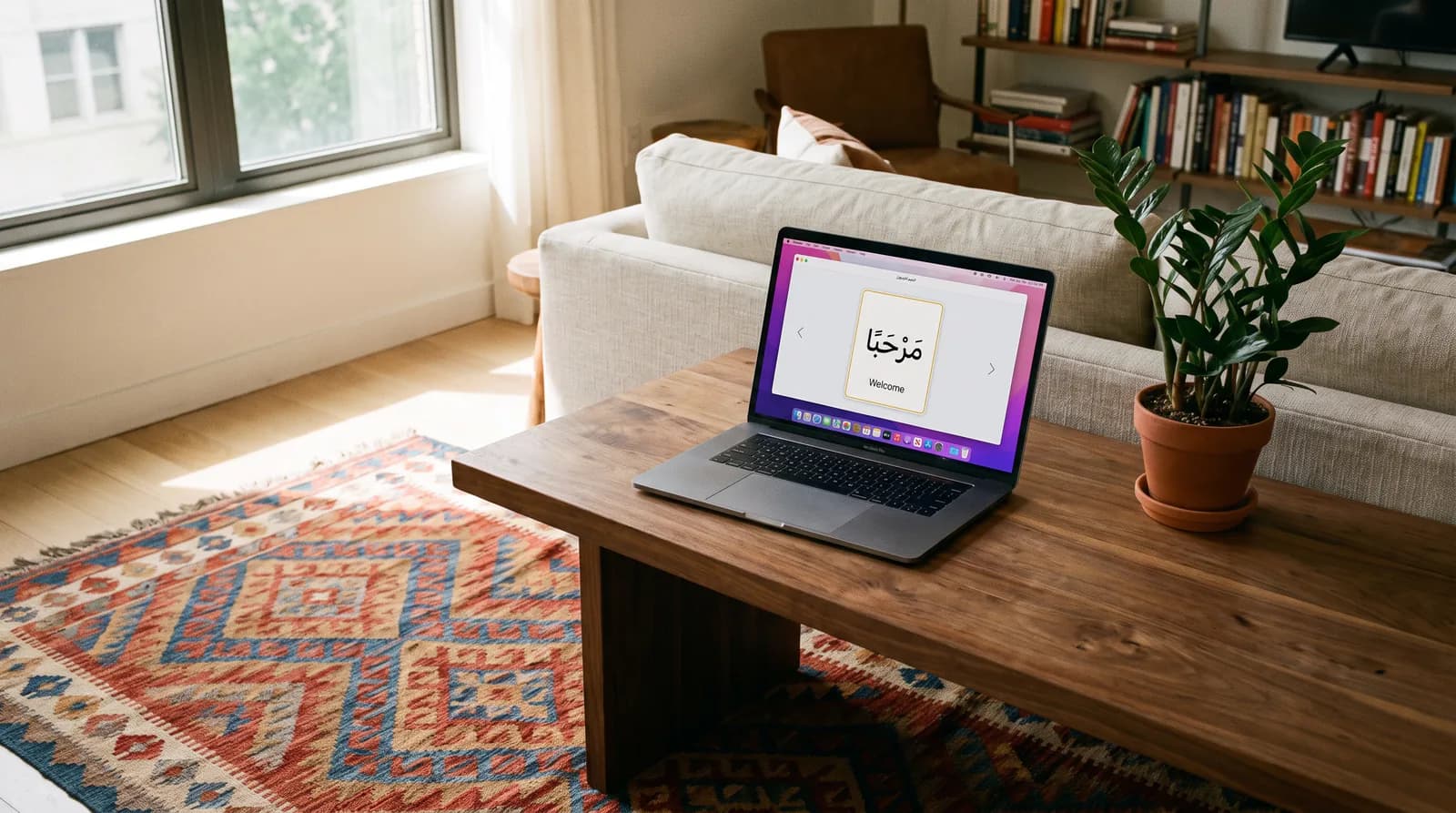
How Western Muslim families can use online Islamic education for academics while strengthening local mosque ties. A hybrid approach for 2026.
When families move to a new suburb for work or school, the nearest mosque with a weekend maktab may be forty-five minutes away. The result is a quiet crisis: parents who want to raise children with strong Islamic foundations find themselves isolated from the very community structures that once made that task easier. Online Islamic education has stepped into this gap, but too often it is framed as a replacement for local community rather than a tool that can strengthen it. This article argues for a different model — one where digital learning handles the heavy academic lifting, freeing families to engage with their local mosque for social and spiritual connection. We will examine the realities of geographical fragmentation, the hidden risks of digital-only religious learning, and how small-group online classes can build global peer networks without sacrificing local ties.
The Reality of Geographical Fragmentation in the Muslim Diaspora
Over the past two decades, Western Muslim communities have become increasingly dispersed. Families that once clustered around urban mosques now live in suburbs, rural areas, or entirely new cities where no established Islamic center exists. This dispersal is not a failure of commitment; it is a structural consequence of housing markets, job mobility, and the natural desire for space and safety. But it has real consequences for religious education.
Traditional weekend maktabs depend on proximity. When a family moves thirty miles from the nearest mosque, attending a two-hour Saturday class becomes a logistical ordeal. Parents must coordinate drives, siblings, meals, and weekend chores around a single activity. For many, the cost in time and stress outweighs the benefit, and children miss out on consistent Islamic instruction. The fragmentation is not just geographical; it is also social. Without regular contact with other Muslim families, parents lose the informal support networks that once helped them navigate Tarbiyah (تربية) — the holistic upbringing of a child in faith and character.
Research from The University of Edinburgh (2022) confirms that digital technologies are reshaping how Muslims access religious knowledge and community. The study notes that online spaces can fill gaps left by physical distance, but they also raise questions about the nature of belonging. Similarly, a 2024 study from White Rose Research Online on mosques and public space in Bradford highlights how local Islamic institutions function not only as prayer halls but as centers of social cohesion and civic engagement. When families cannot access those institutions regularly, both the family and the mosque suffer.
For Western Muslim parents, the challenge is clear: how do you provide rigorous Islamic education without uprooting your life or spending hours in transit? The answer increasingly involves online Islamic education, but the way it is used matters enormously.
Why Online Islamic Education is Filling the Gap
Online Islamic education has grown rapidly because it solves a real problem: access. A family in a small town with no qualified Tajweed (تجويد) teacher can now enroll their child in a live class with a certified tutor. A parent who works weekends can schedule lessons on weekday evenings. The flexibility is not a luxury; it is a necessity for many diaspora families.
Beyond convenience, online platforms democratize access to qualified scholarship. As noted in a 2025 article in Taylor & Francis on online Islamic knowledge sources, digital platforms have changed the authority landscape of Islamic learning. Families are no longer limited to whoever happens to be available locally; they can learn from teachers trained in classical institutions and experienced in Western contexts. This is a significant shift. For subjects like Arabic literacy and Quranic recitation, consistent instruction from a skilled teacher is essential, and online classes can provide that consistency week after week.
However, the same research also warns that digital learning can lead to individualized, isolated religious practice if it replaces communal engagement entirely. The risk is not in the technology itself but in how families integrate it into their lives. If online classes become the only Islamic input a child receives, they may miss the embodied, social dimensions of faith — praying shoulder to shoulder, serving the community, and experiencing the rhythms of a local Muslim life.
The opportunity, then, is not to choose between online and local, but to use online education strategically. By outsourcing the academic heavy lifting to a structured online program, parents free up time and energy to engage with their local mosque for social and spiritual Tarbiyah. This hybrid approach is the subject of the next sections.
The Hidden Risk: Does Digital Learning Weaken Local Ties?
Critics of online Islamic education often point to the loss of physical community. They worry that children who learn exclusively through screens will lack the social cohesion that comes from praying together, sharing meals, and participating in communal events. These concerns are valid. A 2023 study in SciELO SA on the challenges of Islamic education in the new era of information and communication technologies highlights that while digital tools expand access, they can also fragment the communal learning experience.
But the risk is not inevitable. It depends on how families use online education. If online classes are treated as a substitute for all communal involvement, isolation is likely. If they are treated as a specialized academic tool that complements local engagement, the risk diminishes. The key is intentionality.
Consider the analogy of secular schooling. Most parents do not expect their child's math class to provide their entire social life. They enroll children in school for academics and then seek sports, clubs, and playdates for social development. The same logic can apply to Islamic education. Online classes can deliver rigorous instruction in Tajweed, Arabic, and Islamic Studies, while the local mosque becomes the place for friendships, service projects, and congregational prayer.
This division of labor is not a compromise; it is a strategic allocation of limited time and energy. It recognizes that different environments serve different purposes. The local mosque excels at building social bonds and a sense of belonging. Online classes excel at providing consistent, high-quality academic instruction that many local mosques cannot offer due to a shortage of qualified teachers or scheduling conflicts.
For parents worried about screen time, this approach also helps. When online classes are focused and purposeful, they are less likely to become passive entertainment. The child logs in, learns, interacts with peers and teacher, and logs off. The rest of the day is free for offline activities, including mosque attendance.
Building Micro-Communities: The Power of Small-Group Online Classes
One of the most persistent myths about online learning is that it is inherently isolating. This is true for massive lecture-style webinars or pre-recorded videos, but it is not true for live, small-group classes. In fact, small-group online classes can create intimate peer micro-communities that span cities, countries, and even continents.
At Minhaj Kids, classes are capped at three to five students. This size is deliberate. It allows every child to speak, ask questions, and receive individual attention. It also enables genuine relationships to form. Over weeks and months, students in a small group become familiar with each other's voices, struggles, and progress. They encourage one another, celebrate successes, and build a sense of shared journey.
These micro-communities are not a replacement for local friendships, but they are a valuable addition. A child in a small town in Texas might be the only Muslim in their school, but in their online Tajweed class they meet a peer in London and another in Toronto. They discover that they are part of a global community of young Muslims striving to learn the same skills. This expands their sense of identity and belonging.
Research from ResearchGate (2025) on the impact of virtual Islamic learning spaces on student engagement supports this. The study found that when online classes are interactive and well-structured, students report higher engagement and a stronger sense of connection to their peers and teachers than in large, impersonal settings. The small-group model is a key factor in this success.
Moreover, these micro-communities can persist outside class time. Many Minhaj Kids cohorts have parent-led group chats where families share resources, celebrate milestones, and arrange virtual meetups. These connections are especially valuable for families who feel isolated in their local area. They provide a support network that complements, rather than competes with, local mosque ties.
For parents considering online Islamic education, the small-group model is worth prioritizing. It offers the academic benefits of online learning without the social isolation that large platforms can create. To learn more about how small groups work, see our article on why small groups work better.
The Hybrid Approach: Balancing Screen Time with Mosque Time
The hybrid approach is simple in principle but requires intentional planning. The idea is to use online classes for the academic subjects that demand consistent, expert instruction — primarily Tajweed, Arabic literacy, and structured Islamic Studies — while reserving local mosque time for social, spiritual, and communal activities.
Why this division? Because local mosques often struggle to provide advanced instruction in these subjects. A volunteer teacher may be passionate but untrained in Tajweed rules. A weekend maktab may meet only once a week, which is insufficient for building Arabic fluency. Online classes, with qualified tutors and multiple sessions per week, can fill that gap. Meanwhile, the local mosque remains the best place for congregational prayer, Jumu'ah, Eid celebrations, community service, and informal socializing. These are the experiences that build a felt sense of belonging and shared identity.
This approach also addresses the logistical challenges that diaspora parents face. Time zones, school terms, and extracurricular activities can make it difficult to commit to a fixed weekly mosque class. By shifting academic instruction online, families gain flexibility. They can schedule lessons around their unique calendar and still make it to the mosque for Jumu'ah or a monthly community dinner without the pressure of academic catch-up.
For parents who worry about their child missing out on the social aspects of a traditional maktab, the hybrid model offers a solution. The child still attends the mosque, but now the purpose is purely social and spiritual. They are not distracted by worksheets or exams; they are there to pray, play, and connect. This can actually deepen their love for the mosque because it is associated with positive, low-pressure experiences.
To implement this, parents should first identify what their local mosque offers well. Perhaps it has a strong youth group or a vibrant Sunday community lunch. Then, they should choose online classes that cover the academic gaps. For example, a family might enroll their child in an online Tajweed class three times a week and an Arabic class twice a week, while attending the mosque every Friday and for monthly service projects. This balance ensures the child receives both rigorous instruction and communal bonding.
For more on balancing online and offline learning, see our guide on homeschooling Muslim families: balancing academics and Tarbiyah.
Practical Steps to Keep Your Child Connected Locally and Globally
Building a hybrid model requires planning. Here are practical steps for parents who want to give their children both academic excellence and local community ties.
1. Audit Your Local Mosque's Offerings
Before enrolling in online classes, find out what your local mosque actually provides. Does it have a weekend school? A youth group? A monthly community service project? Attend a few events and talk to other parents. Knowing the strengths and gaps will help you decide what to outsource online and what to keep local.
2. Choose Online Classes for Academic Rigor
Focus online enrollment on subjects that require consistent, expert instruction. Tajweed, Arabic grammar, and structured Islamic Studies are ideal candidates. Look for live, small-group classes with qualified teachers. At Minhaj Kids, tutors are Al-Azhar aligned and experienced with Western Muslim families. You can explore our Quran program, Arabic program, and Islamic Studies program to see how they fit.
3. Reserve Mosque Time for Social and Spiritual Activities
Once academics are handled online, protect your mosque time for social and spiritual activities. Attend Jumu'ah as a family. Join the mosque's community service projects. Participate in Eid festivals and potlucks. These are the experiences that build lasting memories and a sense of belonging. They also give your child the chance to see Islam lived out in a community, not just studied in a screen.
4. Foster Global Peer Connections
Encourage your child to build friendships with their online classmates. Many small-group classes have group chats or virtual social events. These connections can be especially valuable for children who are the only Muslims in their local school. They provide a peer network that understands their faith and shares their values. For tips on helping shy children engage, see our article on helping shy children participate in online Quran classes.
5. Manage Screen Time Intentionally
Online learning is screen time, but not all screen time is equal. Live, interactive classes are active learning, not passive consumption. To keep balance, set clear boundaries: no screens during meals, outdoor play every day, and device-free evenings. For more guidance, see our article on screen-based Islamic learning: benefits, risks, and guidelines for parents.
6. Coordinate with Other Families
If you find other families in your area who are also using online classes, consider forming a local study circle. You can meet monthly for a potluck and Quran review, combining the academic benefits of online learning with local social bonding. This is a powerful way to build community even when the mosque is far away.
7. Review and Adjust Regularly
Your family's needs will change over time. What works in one season may not work in another. Schedule a quarterly review to assess whether your child is thriving academically and socially. Adjust your online and local commitments accordingly. For a broader framework, see our guide on measuring Islamic education progress beyond grades.
Choosing the Right Online Foundation for Your Family
Not all online Islamic education programs are created equal. The right program should provide qualified teachers, a structured curriculum, and a format that builds community rather than isolating students. Here are key features to look for.
Live, small-group instruction. Pre-recorded videos and massive webinars cannot provide the interaction and accountability that children need. Look for live classes capped at a small number of students. This ensures your child is seen and heard.
Qualified, experienced teachers. The teacher matters more than the platform. Seek tutors with formal training in Tajweed and Arabic, and experience teaching Western Muslim children. At Minhaj Kids, all tutors are Al-Azhar aligned and undergo background checks. For more on vetting, see our article on vetting online Islamic tutors: quality and safeguarding.
Structured progression. A good program should have a clear scope and sequence. Your child should know what they are learning and why, and you should be able to see progress over time. Avoid programs that jump around without a coherent curriculum.
Recorded sessions for review. Even in live classes, children sometimes miss a point. Recorded sessions allow you to review material at home and reinforce learning. This is especially helpful for busy parents who want to stay involved.
Flexibility for diaspora schedules. Time zones and school terms vary. A good program will offer multiple time slots and accommodate different calendars. Minhaj Kids, for example, schedules classes to serve families in the US, UK, Canada, and Australia.
Community features. Look for opportunities for students to interact outside class, such as group projects, discussion boards, or virtual social events. These features turn a class into a micro-community.
At Minhaj Kids, we designed our program with these principles in mind. Our small-group classes (3–5 students) create intimate peer networks across countries. Our tutors are qualified and experienced. Our curriculum is structured and progressive. And our scheduling is built for Western Muslim families. You can explore our Quran, Arabic, and Islamic Studies programs, or read more about our approach on our about page.
If you are ready to see how a hybrid approach can work for your family, we invite you to Book a free trial. No payment card is required. Visit our fees page to learn more and enroll. You can also contact us with any questions.
For further reading on related topics, explore our blog articles on online Islamic education and community fragmentation, comparing weekend mosque, full-time Islamic school, and online Quran and Arabic literacy, and the state of Islamic education in the Western diaspora: 2026 trends.
References
- Experts assess digital impact on Muslim lives — The University of Edinburgh, 2022.
- Challenges of Islamic education in the new era of information and communication technologies — SciELO SA, 2023.
- Online Islamic knowledge sources and their authority in Islamic learning — Taylor & Francis, 2025.
- The Impact of Virtual Islamic Learning Spaces on Student Engagement — ResearchGate, 2025.
- Mosques and the Public Space: Conflict and Cooperation in Bradford — White Rose Research Online, 2024.