
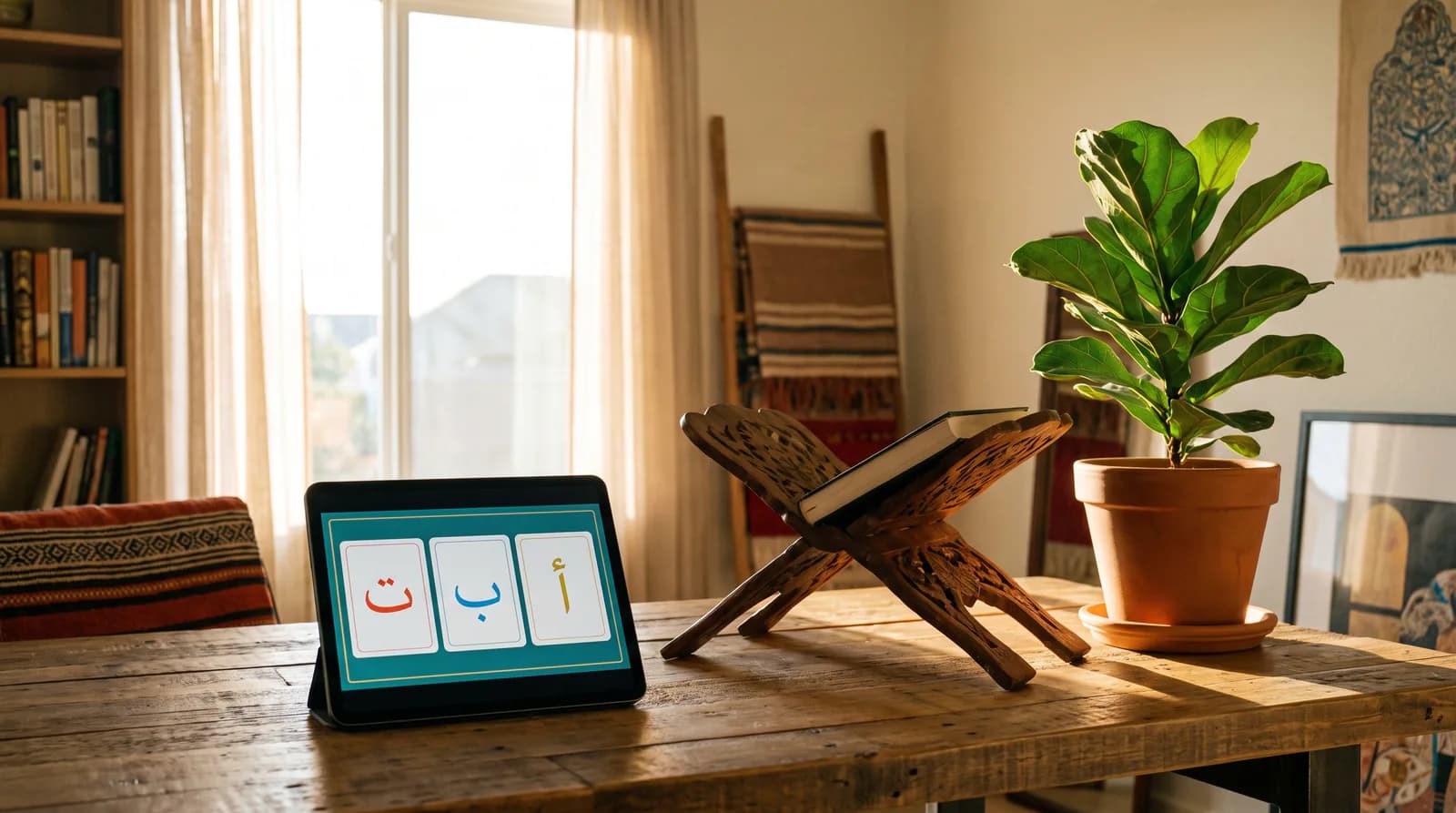
Are online Islamic classes too much screen time? Discover evidence-informed guidelines on active vs passive learning and screen limits for Muslim children.
As a Muslim parent in the West, you face a unique challenge: you want your child to learn Quran, Arabic, and Islamic studies from qualified teachers, but local options are often limited. Online classes offer a lifeline, yet you worry about screen time. Is adding another hour in front of a screen harmful? The answer, grounded in the latest pediatric research, is more nuanced than a simple yes or no.
The Screen Time Dilemma for Muslim Families in the West
For many diaspora families, online Islamic education is not a luxury—it's a necessity. Local mosques may lack certified Quran teachers, weekend schools may be overcrowded, and full-time Islamic schools may be unavailable. Digital platforms bridge this gap, but they also add to your child's daily screen exposure. The guilt is real: you want your child to connect with their deen, but you also want to protect them from the harms of excessive screen use.
This dilemma is compounded by conflicting advice. Some sources preach rigid time limits, while others dismiss screen time concerns entirely. The truth lies in understanding what kind of screen time you're offering and what it replaces.
Decoding the 2026 AAP Guidelines: Quality Over Quantity
The American Academy of Pediatrics (AAP) updated its screen time guidelines in 2025 and 2026, shifting away from strict daily limits for children over five. Instead, the focus is now on quality, context, and displacement (Screen Time Guidelines — American Academy of Pediatrics, 2025). The key question is no longer "How many hours?" but "What is the child doing?" and "What is being displaced?"
According to Updated AAP recommendations for screen time: What parents need to know (CHOC Health, 2026), the guidelines emphasize that screen time becomes harmful when it replaces sleep, physical activity, or face-to-face family interaction. A child who attends a live online Quran class but still gets adequate sleep, plays outdoors, and eats dinner with the family is not at the same risk as a child who passively watches videos for hours alone.
For Muslim parents, this is liberating. It means that a structured, interactive online Islamic class can be part of a healthy digital diet—as long as it doesn't crowd out essential offline activities.
Active vs. Passive Screens: Why the Difference Matters for Tarbiyah
Educational research consistently distinguishes between active and passive screen time. Active screen use involves creating, communicating, or problem-solving—like participating in a live class, typing an answer, or reciting back to a teacher. Passive screen use involves consuming content without interaction—like watching a pre-recorded video or scrolling through social media.
As Active vs passive screen time (The Voice Of Early Childhood, 2025) explains, passive screen time is linked to attention difficulties, poorer language development, and sleep problems. Active screen time, especially when it involves real-time interaction, supports cognitive and social development.
This distinction is critical for Tarbiyah (تربية)—the Islamic concept of holistic upbringing that requires active mentorship, guidance, and relationship-building. Tarbiyah cannot be achieved through passive consumption. A child watching a pre-recorded Islamic cartoon is not receiving Tarbiyah; they are merely being entertained. In contrast, a child in a live online class who recites Quran, asks questions, and receives immediate feedback from a teacher is engaged in active learning that aligns with Islamic educational principles.
Minhaj Kids embodies this active approach. All classes are live, with teachers who hold Ijaza (certification) and are trained to engage students in discussion, correction, and encouragement. This is screen time that builds character and knowledge, not just screen time that fills time.
Synchronous Learning: The Power of Live Human Connection
Not all online learning is created equal. Synchronous (live) learning offers benefits that asynchronous (pre-recorded) learning cannot match: immediate feedback, social presence, and accountability. Research shows that students in synchronous classes retain more information, feel more connected to their teachers, and are less likely to disengage.
For Islamic education, this is especially important. Quran recitation (Tilawah, تلاوة) requires correction of Tajweed (تجويد)—the rules of proper pronunciation. A pre-recorded video cannot hear a child's mistake and correct it. A live teacher can. Similarly, learning Arabic conversation or Islamic studies involves questions, discussions, and personalized guidance that only a live instructor can provide.
Minhaj Kids offers private 1:1 classes (one child per class) and 1:1 sessions, ensuring that every child receives individual attention. This structure maximizes the benefits of synchronous learning while minimizing the distractions common in larger online settings.
Balancing Online Education with Offline Development
Even the best screen time should be part of a balanced lifestyle. The AAP's displacement principle reminds us that screen time becomes problematic when it replaces essential activities. For Muslim children, these include:
- Sleep: Ensure your child gets age-appropriate sleep (9–12 hours for school-age children). Avoid screens at least one hour before bedtime.
- Physical activity: Outdoor play, sports, and family walks should be non-negotiable. Online classes should not replace active play.
- Family interaction: Meals together, conversations, and shared activities (like praying together) should take priority over screens.
- Unstructured play: Creativity and social skills develop through free play, not structured screen time.
When you schedule your child's online Islamic class, think of it as part of a weekly routine that also includes offline Quran review, physical activity, and family time. The goal is not to eliminate screens but to ensure they serve a purpose and don't dominate the day.
How Minhaj Kids Aligns with Evidence-Informed Screen Use
Minhaj Kids was designed with these principles in mind. Unlike platforms that offer pre-recorded courses or large, impersonal classes, Minhaj Kids provides:
- Live, interactive classes with qualified, Ijaza-certified teachers who engage students actively.
- Private 1:1 class sizes (one child per class) to ensure individual attention and minimize passive observation.
- Structured curriculum that progresses systematically, keeping children engaged and motivated.
- Parent involvement through regular progress reports and tips for offline reinforcement.
By choosing Minhaj Kids, you are choosing screen time that is active, relational, and educational—exactly the type of screen use that pediatricians recommend. You can let go of the guilt and embrace this tool for your child's Tarbiyah.
Practical Digital Diet Guidelines for Your Household
Here are actionable steps to implement evidence-informed screen use in your home:
- Prioritize live over recorded. Choose live online classes over pre-recorded videos for core Islamic learning.
- Co-engage when possible. Sit with your younger child during online classes. Ask them what they learned.
- Set screen-free zones. No screens in bedrooms or at the dinner table. This protects sleep and family time.
- Balance with offline activities. Ensure your child has time for physical play, hobbies, and social interaction outside of screens.
- Model healthy habits. Let your child see you using screens purposefully and putting them away when it's family time.
- Use screen time as a tool, not a reward. Frame online Islamic classes as a positive opportunity, not a punishment or bribe.
- Monitor displacement. If online classes start replacing sleep or play, adjust the schedule.
As New AAP 'Screen Time' Recommendations Focus Less on Screens, More on Family Time (EdSurge, 2026) notes, the emphasis is on family connection, not screen elimination. Online Islamic learning, when done right, can strengthen your child's connection to their faith and to you.
Conclusion: Confidently Use Screens for Tarbiyah
The latest pediatric research frees Muslim parents from the burden of blanket screen-time guilt. By choosing active, live, and relational online learning—like the classes offered by Minhaj Kids—you are providing your child with high-quality educational screen time that supports their Tarbiyah. The key is balance: ensure that online learning enhances, rather than replaces, sleep, play, and family interaction.
Ready to give your child the gift of live, interactive Islamic education without the guilt? Explore our programs and fees.
References
- Screen Time Guidelines — American Academy of Pediatrics, 2025.
- Updated AAP recommendations for screen time: What parents need to know — CHOC Health, 2026.
- Active vs passive screen time — The Voice Of Early Childhood, 2025.
- New AAP 'Screen Time' Recommendations Focus Less on Screens, More on Family Time — EdSurge, 2026.
- Setting Healthy Screen Time Limits for Students Learning Online — Connections Academy, 2025.