
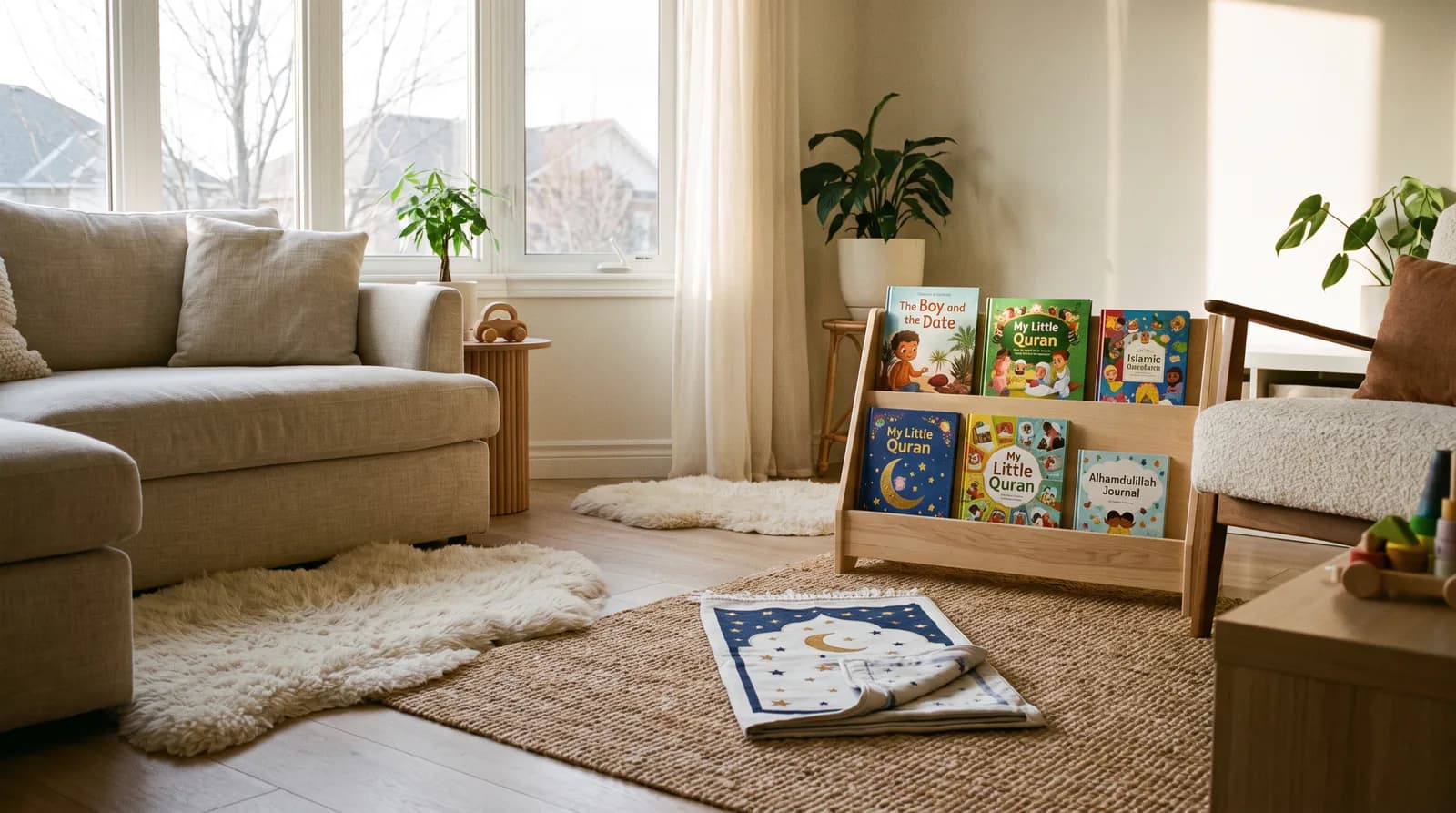
A 2026 guide for Western Muslim parents on assessing Tarbiyah through character, curiosity, and adab — not just juz counts and grades.
The Trap of the 'Juz Count': Why Quantitative Metrics Aren't Enough
Every parent wants to know: Is my child actually growing in their faith? In Western Muslim communities, the easiest answer often comes in numbers. Five juz memorized. Two hundred Arabic vocabulary words. A 94% on the weekend school exam. These metrics feel solid because they are visible, comparable, and reportable. But they tell a partial story at best.
Research on assessment in Islamic religious education consistently shows that cognitive testing dominates because it is the simplest domain to measure — yet holistic assessment must explicitly include affective (emotional and spiritual) and psychomotor (behavioral and worship) domains. When we reduce progress to juz counts and quiz scores, we risk raising children who can recite beautifully but who do not know how to live Islam when no one is watching.
This is not an argument against memorization. Hifdh is a noble and worthy pursuit. But it is one thread in a much larger tapestry of Tarbiyah (تربية) — the patient, holistic cultivation of a child's faith, character, and relationship with Allah.
There is also a quieter cost to over-reliance on numbers: it can quietly teach a child that faith is a performance for adults. A nine-year-old who senses that her worth rises and falls with her recitation score may begin to hide her struggles, avoid difficult surahs, or perform piety she does not yet feel. The metric crowds out the very thing it was meant to serve. The alternative is not to abandon measurement but to widen it — to build a picture of your child that includes what they know, what they feel, and how they behave when the classroom door is closed.
Redefining Success: What Holistic Islamic Education Looks Like
For Muslim families in the West, the context is unique. Our children navigate secular schools, diverse peer groups, and cultural pressures that children in Muslim-majority countries may not face in the same way. Most academic studies on Islamic education assessment focus on full-time schools in Muslim-majority contexts. The supplementary nature of Western Islamic education — weekend classes, evening halaqas, online programs — demands a different assessment lens.
A holistic framework asks three questions simultaneously:
- Cognitive: Does my child understand Islamic concepts, stories, and teachings?
- Affective: Does my child feel connected to Allah, love the Prophet ﷺ, and find joy in worship?
- Psychomotor: Does my child's behavior reflect Islamic values in daily life — at home, at school, and with friends?
These three domains are inseparable. A child who memorizes Surah Al-Fatihah but never sees their parents pray is learning something different from what we intend. A child who aces an aqeedah quiz but mocks a classmate is not demonstrating Islamic character. True assessment requires looking at the whole child.
This is why at Minhaj Kids Islamic Studies, we emphasize character and adab alongside knowledge. Our teachers are trained to observe not just what a child knows, but how they treat others, how they respond to difficulty, and how they engage with faith questions.
Key Indicators of Spiritual and Character Growth in Children
What does spiritual growth actually look like in a child? It rarely appears as a dramatic transformation. More often, it shows up in small, consistent moments that parents can learn to recognize.
1. Voluntary Worship and Remembrance
A child who begins to pray voluntarily — not because you told them to, but because they want to — is showing affective growth. This might look like a seven-year-old asking to join Fajr prayer, or a ten-year-old making dua for a friend without prompting. These are the psychomotor signs that faith has moved from information to internalization.
Be careful not to over-celebrate or turn these moments into performance. The goal is sincerity, not applause. For guidance on building love for salah without pressure, see our article on building love for salah and deen without pressure.
2. Emotional Regulation Through an Islamic Lens
How does your child react when they lose a game? When a sibling takes their toy? When a friend says something unkind? A child who pauses and says "Alhamdulillah" after a disappointment, or who chooses not to retaliate when wronged, is demonstrating that Islamic values are shaping their emotional responses.
This is not about perfection. It is about direction. A child who occasionally fails but recovers with awareness is growing. A child who never struggles may simply not be challenged enough.
3. Curiosity About Faith
Questions are a sign of life. A child who asks "Why does Allah want us to fast?" or "What happens to people who never heard about Islam?" is engaging with their faith at a deeper level. This curiosity should be welcomed, not silenced. Research on spiritual development in children emphasizes that nurturing this questioning spirit in early years builds a foundation for lifelong faith.
4. Application of Islamic Values in Daily Choices
Does your child choose halal snacks when you are not around? Do they speak up when a friend uses inappropriate language? Do they show kindness to someone outside their friend group? These behavioral markers are the clearest evidence of internalized values.
For families navigating the complexities of secular school environments, our article on Muslim teens, social media, and peer pressure offers practical protective strategies.
5. Repair After Failure
One of the most overlooked indicators of growth is not the absence of mistakes but the speed and sincerity of repair. A child who snaps at a sibling and then, unprompted, apologizes and asks for forgiveness is showing that Islamic values have become a reflex, not a rule. Watch for the child who returns to good behavior after a bad day — that return is the muscle of Tarbiyah being built.
Assessing Adab: How Your Child Behaves Outside the Classroom
Adab — Islamic etiquette and character — is the most visible fruit of Tarbiyah. But it is also the most difficult to assess in a formal setting. A child can be perfectly polite in a classroom and entirely different at home. This is why assessment must extend beyond the classroom walls.
At Home: The Unfiltered Environment
Home is where children are most themselves. Observe:
- How does your child speak to siblings? To you when they are frustrated?
- Do they say "Bismillah" before eating without being reminded?
- Do they show gratitude for small things?
- How do they respond when asked to do a chore?
These moments are not about creating a checklist for your child to perform against. They are about noticing patterns over time. A single rude response does not indicate failure. A consistent pattern of disrespect might signal that deeper conversations are needed.
At Secular School: The Hidden Test
Your child's behavior at school — where Islamic values may not be reinforced — is a powerful indicator of internalization. Ask yourself:
- Does my child maintain their Islamic identity with confidence?
- Do they treat classmates of all backgrounds with respect?
- Do they navigate situations involving haram with maturity?
For children in public school settings, building a strong Muslim identity is essential. Our article on raising Muslim children in the West with identity and belonging explores this further.
With Peers: The Social Mirror
How your child behaves with Muslim peers reveals much about their understanding of brotherhood and sisterhood in Islam. Do they include others? Do they gossip? Do they stand up for someone being teased?
In our small live groups of 3-5 students, teachers observe these peer dynamics directly and can report on them — something impossible in a crowded weekend school or a pre-recorded video course.
The Role of Curiosity: Welcoming Questions About Faith
Some parents worry when their child asks difficult questions about Islam. But questions are not a sign of weak faith — they are a sign of active engagement. The child who asks "Why does Allah allow suffering?" is not losing their faith; they are building it.
Research on character education emphasizes that continuous observation and dialogue over time — not a single end-of-term exam — is what truly shapes moral development. This means parents should view faith questions as opportunities for connection, not threats to authority.
If your child is expressing doubt, our guide on supporting Muslim adolescents through faith doubt offers a compassionate framework.
At Minhaj Kids, teachers are trained to welcome questions in live classes. This is one of the key advantages of small-group online learning: there is space for dialogue, and teachers can gauge a child's understanding in real time.
Partnering with Teachers: The Minhaj Kids Approach to Progress
One of the biggest challenges in online Islamic education is the isolation factor. In a pre-recorded course, no one sees your child. In a large online class, the teacher may not notice if your child is struggling or disengaged. This is where small live groups make a measurable difference.
Small Groups, Real Observation
At Minhaj Kids Quran program, classes are capped at 3-5 students. This allows teachers to:
- Observe each child's adab and participation in real time
- Notice peer interactions and social dynamics
- Provide individualized feedback on Tajweed (تجويد) and Tilawah (تلاوة)
- Track emotional engagement and curiosity
These observations are not just for the teacher. They are shared with parents through regular progress reports that go beyond grades — focusing on character, effort, and engagement.
Beyond the Report Card
Traditional report cards tell you what a child scored. Our progress reports tell you how your child is growing. We comment on:
- Willingness to try and make mistakes
- Kindness toward classmates
- Curiosity and question-asking
- Consistency in practice
This approach aligns with research from the Jubilee Centre on character education, which emphasizes that assessment should capture virtues in action, not just knowledge retained.
For families interested in Arabic language development alongside Quran, our Arabic program also uses small-group live instruction. You can read about how this builds confidence in our article on Arabic speaking confidence in small-group classes.
Practical Ways to Track Your Child's Tarbiyah at Home
You do not need a degree in education to assess your child's spiritual growth. You need attention, consistency, and a framework. Here are practical steps for busy parents.
1. Keep a Simple Journal
Once a week, jot down one observation for each child. It could be a moment of kindness, a question they asked, or a struggle they had. Over time, you will see patterns. This is not about grading — it is about noticing.
Consider using a gratitude journal alongside your child to model reflection. A shared notebook where each of you writes one thing you were thankful to Allah for that week turns assessment into a family ritual rather than an audit.
2. Have Regular, Low-Pressure Conversations
Instead of "What did you learn today?" try "What made you think today?" or "Was there anything you wondered about?" These open-ended questions invite reflection rather than recitation.
3. Observe Transitions
Pay attention to how your child transitions between environments — from school to home, from play to prayer. These moments often reveal the depth of internalization.
4. Involve the Whole Family
Tarbiyah is not a solo project. When siblings and parents model Islamic values, children learn through observation. Family discussions about Islamic topics, even brief ones, reinforce that faith is a lived reality.
5. Communicate with Teachers
If your child is enrolled in a program like Minhaj Kids, use the teacher as a partner. Ask about adab and participation, not just memorization. Share what you observe at home. This collaboration creates a fuller picture.
6. Celebrate Growth, Not Just Achievement
When your child shows patience, honesty, or kindness, name it. "I noticed you were patient with your sister today. That is beautiful character." This reinforces that you value the inner journey, not just the outer performance.
7. Review Quarterly, Not Weekly
Spiritual growth is slow by design. Resist the urge to reassess every week. Set aside one evening each quarter to read back through your journal and ask: what has changed in how my child talks about Allah, treats others, and handles difficulty? This longer horizon protects you from mistaking a bad week for a bad trajectory.
Conclusion: Measuring What Matters
Measuring progress in Islamic education is not about abandoning metrics. It is about expanding them. Juz counts and quiz scores have their place, but they are not the whole picture. True progress is seen in a child who prays voluntarily, who treats others with adab, who asks questions about faith, and who carries Islamic values into every environment.
For Western Muslim parents, this holistic approach is both more challenging and more rewarding. It requires us to slow down, observe, and trust the process of Tarbiyah. It also requires educational partners who see our children as whole beings, not just students to be tested.
At Minhaj Kids, our small live groups are designed for exactly this kind of holistic observation and support. If you are ready to partner with teachers who will notice your child's character, not just their memorization, Book a free trial or view fees and enroll. You can also learn more about our approach or contact our team with questions.
For further reading, explore our related articles on moving from Sunday school to lifelong learning, measuring progress beyond grades, and the state of Islamic education in the Western diaspora.
References
- Character Education: Evaluation Handbook for Schools — Jubilee Centre for Character and Virtues, University of Birmingham, 2024.
- Character Education Framework Guidance — UK Department for Education, 2019.
- Holistic Assessment in Religious Education: Cognitive, Affective and Psychomotor Domains — ERIC, Education Resources Information Center.
- Nurturing the Spiritual Development of Children in the Early Years — Jubilee Institute for Learning, 2022.
- Assessment for Learning: Beyond Summative Grades — UK Department for Education.