
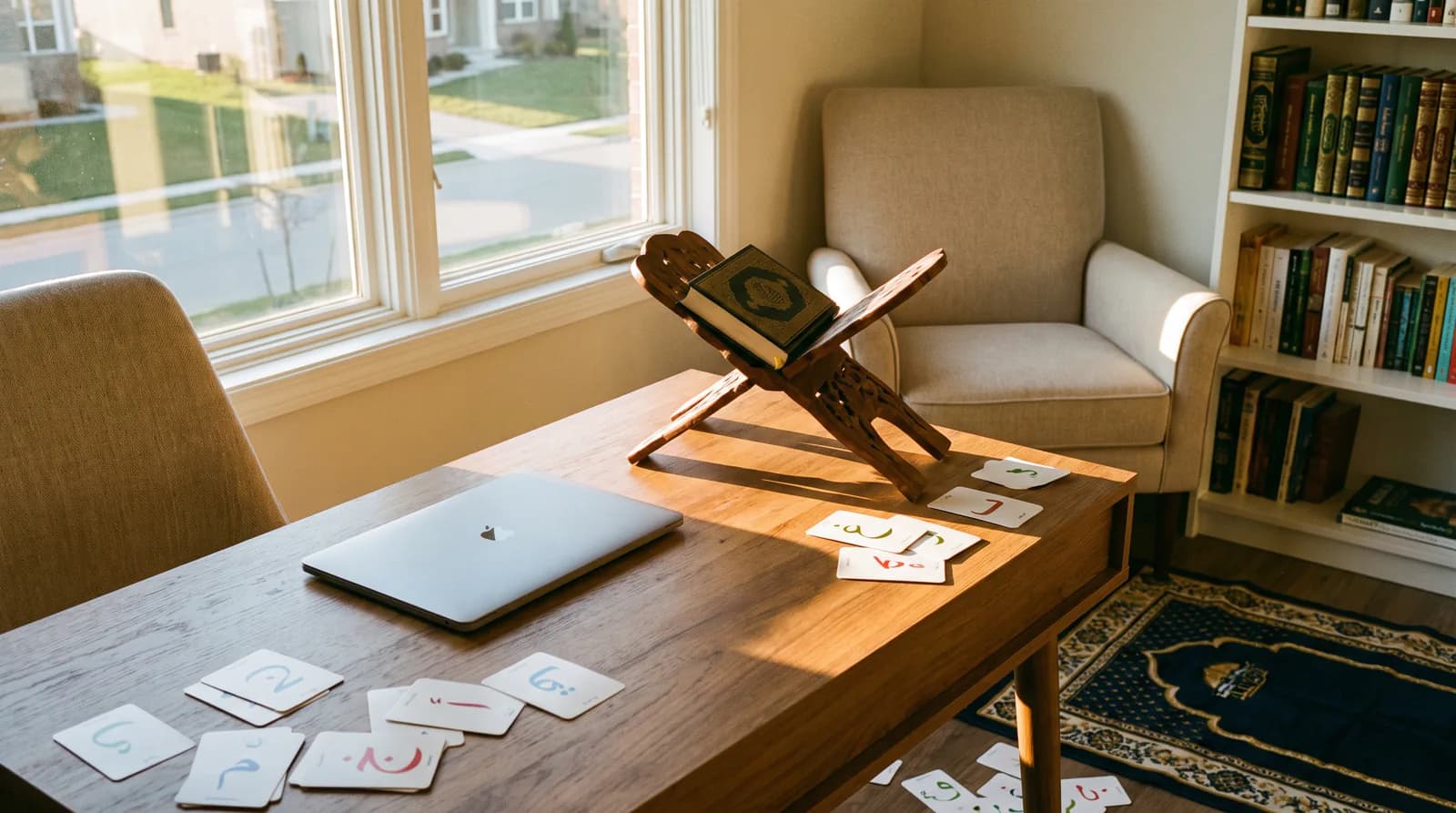
Compare Quran, Tajweed, and Arabic literacy outcomes across full-time Islamic schools, weekend maktabs, and 1:1 live online classes for Western Muslim families.
For Western Muslim parents in 2026, the question is no longer whether to teach children Quran and Arabic, but where—and the answer is rarely simple. The three dominant models—full-time Islamic schools, weekend maktabs at the local mosque, and live online programs—each promise literacy but deliver very different outcomes. This guide cuts through the marketing to compare what actually works for Tajweed (تجويد), Tilawah (تلاوة), and Arabic fluency, with a focus on the specific pain points diaspora families face.
The 2026 Dilemma: Balancing Deen, Academics, and Time
Most parents we speak with are caught in a trilemma: full-time Islamic school is either unavailable or unaffordable; the weekend maktab is convenient but slow; and online classes seem isolating. The result is often a patchwork of activities that leaves children exhausted and parents frustrated. The core issue is not effort—it is the structure of instruction. Group settings, no matter how well-intentioned, cannot provide the individual feedback required for precise Quran recitation. This is where 1:1 online classes change the equation.
Before comparing models, it helps to understand the terms. Tajweed (تجويد) refers to the rules of correct pronunciation; Tilawah (تلاوة) is the act of reciting the Quran melodiously; and Tarteel (ترتيل) means reciting slowly and distinctly, giving each letter its due. These are not abstract ideals—they are measurable skills that require expert correction.
Full-Time Islamic Schools: Immersion vs. Accessibility
Full-time Islamic schools offer the gold standard for Arabic immersion: daily Tilawah, Islamic studies woven throughout the day, and a peer environment that normalizes religious practice. However, they come with two major barriers. First, cost: tuition ranges from $5,000 to $15,000 per year, putting them out of reach for many families. Second, availability: waitlists are common, and outside major metropolitan areas, they simply don’t exist.
Even when accessible, full-time schools often suffer from high student-teacher ratios. A class of 20+ students means individual Tajweed correction is limited. Children may memorize surahs but still struggle with makharij (articulation points) because the teacher cannot hear every subtle error. For families who can afford it, full-time school provides excellent Tarbiyah (تربية) and social cohesion—but it may not guarantee precise recitation.
Consider a typical scenario: a nine-year-old at a full-time Islamic school in a mid-sized city memorizes Juz 30 over two years. Her parents are proud, but when they listen closely, she pronounces ḥāʾ (ح) as hāʾ (ه) and skips the ghunnah on nūn mushaddadah. The teacher, managing 22 students, has never had a chance to isolate those errors. The memorization is real, but the recitation foundation is shaky. This is not a failure of the school’s intent—it is a structural limitation of group instruction.
Weekend Maktabs: The Community Hub with a Time Deficit
The weekend maktab remains the backbone of Islamic education for most diaspora communities. It builds identity, fosters friendships, and anchors children in the local mosque. Yet the math is unforgiving: 2–4 hours per week divided among 15+ children means each child receives only 3–5 minutes of direct Tajweed instruction. In that window, a teacher cannot diagnose persistent pronunciation errors, let alone correct them.
This time deficit produces the “perpetual Qaida” syndrome—a term we hear repeatedly from parents whose children have spent years in weekend school without advancing beyond the introductory Qaida book. The child may recognize letters but cannot recite a page of the Quran independently. The problem is not the child’s ability; it is the absence of focused, repetitive practice with immediate feedback.
Weekend schools excel at community building and basic Islamic identity, and they should be celebrated for that. But for Quran literacy, they are structurally limited.
There is also a hidden curriculum problem. Because weekend maktabs often rely on volunteer teachers with varying levels of Tajweed training, the quality of correction varies wildly from classroom to classroom. One teacher may have an ijazah in recitation; another may be a well-meaning parent who learned to read Quran as a child but never studied the rules formally. Parents rarely know which they are getting. This inconsistency compounds the time deficit: even the few minutes of instruction a child receives may not be technically accurate.
Tajweed Classes Online vs Weekend School: Measuring Recitation Outcomes
When we compare Tajweed classes online vs weekend school, the difference in recitation outcomes is stark. In a 1:1 online session, the teacher hears every letter, every ghunnah, every madd. Corrections are immediate and personalized. In a weekend maktab, the teacher hears a chorus—and in a chorus, subtle errors hide.
Consider a child who consistently mispronounces ḍād (ض) as dāl (د). In a group of 15, that error may go unnoticed for months. In a 1:1 session, the tutor identifies it in the first class and builds a targeted correction plan. This is why 1:1 online programs like Minhaj Kids achieve faster independent reading and more precise Tajweed: the feedback loop is tight and consistent.
Moreover, online sessions are often recorded, allowing parents to review and children to practice between classes. This reinforces the principle that multiple short sessions beat one long weekly session for retention—a principle weekend schools struggle to apply due to time constraints.
To make this concrete, think about the feedback cycle. In a weekend maktab, a child recites once a week and receives a general comment like “good, keep practicing.” In a 1:1 online class, the child recites, hears a correction, repeats the corrected sound, and receives immediate confirmation—all within 30 seconds. Over a month, that is dozens of micro-corrections versus four vague encouragements. The difference in muscle memory and confidence is enormous.
The Importance of 1:1 Attention for Proper Tilawah and Tarteel
Tarteel is not just slow recitation; it is a discipline of precision. It requires a teacher who can model correct pronunciation and listen critically. In a group setting, children learn to recite in unison, which masks individual errors and discourages the kind of careful, halting recitation that builds mastery.
1:1 online classes solve this by design. Each 30-minute session is uninterrupted reading and correction. The tutor can focus entirely on the child’s makharij, rhythm, and fluency. For shy children, this is transformative: they can practice Tarteel without peer judgment. Many parents report that their children, who were silent in weekend school, become vocal and confident in one-on-one online classes. (For more on this, see our guide on helping shy children participate in online Quran classes.)
The result is not just better Tajweed—it is a deeper connection to the Quran. When a child recites with correct Tarteel, they feel the beauty of the words, and that feeling motivates further practice.
There is a spiritual dimension here that is easy to overlook. The Quran commands us to recite it in Tarteel (73:4), and classical scholars emphasized that beautiful, correct recitation softens the heart. A child who stumbles through recitation without correction learns to associate the Quran with frustration. A child who is gently corrected and hears their own voice improve learns to associate it with beauty and mastery. The instructional model shapes not just skill but attachment.
Arabic Literacy: Which Model Actually Builds Fluency?
Arabic literacy is a broader challenge. Full-time Islamic schools win on immersion: children hear and speak Arabic daily, and subjects like Islamic studies are taught in Arabic. This environment builds conversational fluency and vocabulary naturally. However, even full-time schools may not produce strong readers if the curriculum lacks systematic phonics and reading practice.
Weekend schools often struggle beyond alphabet recognition. With limited time, teachers focus on Quran recitation rather than Arabic grammar or conversation. Children may learn to read Quranic script but cannot understand or speak Arabic.
Online 1:1 programs occupy a middle ground: they offer targeted, conversational practice and reading drills tailored to the child’s level. At Minhaj Kids, our Arabic program focuses on both Quranic Arabic and modern standard Arabic, with an emphasis on reading fluency and comprehension. While online cannot replicate the full immersion of a school day, it provides the focused practice that builds real literacy—especially when combined with community exposure.
For heritage speakers—children who hear Arabic at home but answer in English—the gap is often vocabulary and grammar, not pronunciation. A 1:1 tutor can diagnose exactly where the child’s comprehension breaks down and build a bridge. For more on this, see our guide on Arabic literacy for heritage speakers.
The Hybrid Approach: Combining Local Community with Online Precision
The most effective strategy for many families is hybrid: use the weekend maktab for socialization, Islamic studies, and community bonding, but rely on 1:1 online classes for dedicated Tajweed and Tilawah progress. This combines the strengths of both models.
For example, a child might attend weekend maktab on Saturdays for Quran memorization and Islamic studies, and take two 30-minute online Tajweed classes per week. The online sessions provide the individual correction the maktab cannot, while the maktab provides the peer environment and mosque connection. This hybrid approach is increasingly popular among diaspora parents who want both community and quality.
Cost-wise, this is also viable. Minhaj Kids offers plans starting at $39/month for group classes, $69/month for the Focused plan (1:1), and $99/month for the Intensive plan (more frequent 1:1 sessions). Compared to private tutors who charge $30–$60 per hour, our 1:1 plans provide structured, Azhari-trained tutors at a fraction of the cost. For a detailed breakdown, see our fees page.
To make the hybrid model work, parents need a simple weekly rhythm. Here is one that many families use successfully:
- Saturday morning: Weekend maktab for Quran memorization, Islamic studies, and social connection.
- Tuesday evening: 30-minute 1:1 online Tajweed session focused on correcting errors from the week’s memorization.
- Thursday evening: 30-minute 1:1 online Tilawah or Arabic reading session.
- Daily (10 minutes): Child practices the corrected portion aloud to a parent, reinforcing the tutor’s feedback.
This rhythm keeps the child connected to the mosque while ensuring that recitation errors are caught and corrected weekly rather than accumulating for months.
How Minhaj Kids Supports Western Muslim Families
At Minhaj Kids, we designed our programs to address the exact gaps identified in this comparison. Our Quran program is entirely 1:1, ensuring that every child receives undivided attention. Our tutors are qualified Azhari scholars who understand the challenges of diaspora children. Sessions are recorded for review, and our curriculum is structured for steady progression—no more perpetual Qaida.
We also offer Islamic studies to complement Quran learning, and our article on systemic failures in Tajweed instruction dives deeper into why group settings fail. For parents concerned about screen time, we recommend reading our guidelines on screen-based learning.
Our approach is not to replace the mosque or the community, but to fill the gap that weekend schools and full-time schools cannot. Whether you choose our Focused plan at $69/month or the Intensive at $99/month, you are investing in precise, personalized instruction that builds lifelong Quran literacy.
Ready to see the difference? Book a free trial to experience a 1:1 session, or view fees and enroll to find the right fit for your family. You can also learn more about our approach and contact us with any questions.
References
- Weekend Islamic Schools: Are They Preparing Children for Life Ahead? — Institute for Social Policy and Understanding, 2018.
- Youth Empowerment, Holistic Education, and Islamic Weekend Schools — IIIT, 2022.
- Supplemental Educational Services and Student Outcomes — U.S. Department of Education, 2023.
- Why Weekend Islamic School? — SoundVision, 2023.